Where Shadows Slumber: Staying Motivated

One of the most difficult parts of game development is staying motivated. I can’t tell you how many projects I’ve started, a great idea and achievable goal in mind, only to have those projects fall by the wayside, almost but not quite finished. Last time I talked about dealing with adversity; this week, I’m going to talk about how to stay motivated when working on a game development project.

As game developers, we love games, and we love developing games. When you first come up with a great concept for a game, you’re excited about it. You have so many great ideas, and you just can’t wait to implement them. You have an image of what your game will look like in 2 years, and with that pristine goal in mind, you simply feel driven to work on it.

As you work on your game, however, that drive begins to falter. Where you once looked forward to sitting down for an hour or two of coding, you find yourself shying away from your computer. You look at your game and all the effort you’ve put into it, and you realize how far away you are from the perfect game you had imagined. Rather than tackling cool, big-picture things like core mechanics, you find yourself slogging through your levels, double-checking initialization values.

Basically, there comes a time in the development of a game where the fun parts are over. Your motivation is at its lowest, the work is the least interesting it’s been so far, and your noticeable progress has slowed to a crawl. You find yourself with a solid, but definitely half-finished game, and it feels like it will never be any more than that.

Depressing, huh? Let’s find out how to avoid letting your game succumb to this fate!
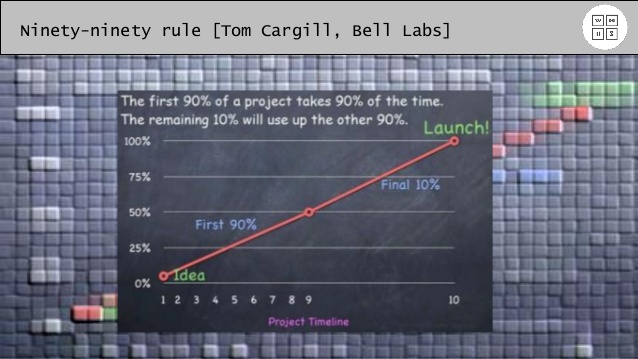
 

webcamp-2016-pm-bpa-rd-17-638

“The first 90 percent of the code accounts for the first 90 percent of the development time. The remaining 10 percent of the code accounts for the other 90 percent of the development time.” – Tom Cargill, Bell Labs

The Ninety-Ninety Rule


The ninety-ninety rule is a saying that describes a lot of the difficulties associated with software development. It works on two levels, both of which are relevant here.

First, the shrewd reader will notice that the total development time in the quote adds up to 180%. This, of course, cannot be true in a literal sense; rather, this is a reference to the fact that estimates of development time for a project are almost always woefully low. If this is to be believed, then these projects take almost twice as long as estimated! In my experience, this is very accurate.

Secondly, we can look at the values used above. We see that the last ten percent of the code accounts for just as much time as the first ninety percent! While this seems nonsensical, it is perfectly true. Anyone who has made it 90% of the way through a software project can attest that the last 10% always drags on and on. When developing Where Shadows Slumber, for instance, I found myself with a game in which every core game mechanic was completely developed within 10 months of starting! And yet here we are, nearly two years into development, and the game is still not complete (and not just because I’ve been slacking off this whole time).

The ninety-ninety rules helps explain why we start to feel so depressed as we reach what appears to be the 90% mark of our game. We feel like our game is almost done, and it’s taken just as much time as expected – awesome, we should be done in a few more weeks! What we don’t realize is that we’re really only halfway done. Since we don’t realize that fact, we don’t understand why our expected release date has came and gone. We missed our deadline, our project is dragging on, we aren’t really enjoying the work anymore, and we still don’t understand why the last 10% of the work is taking forever. With all of these things weighing down on us, it’s understandable when we start to lose faith in our game.

So, now that we understand some of the reasons behind this phenomenon, lets look at some ways to deal with it.

 

climbing_2651239b


Set Realistic Expectations

A big part of the problem is feeling like you’re falling short of what you should be doing. The problem, however, isn’t with your work – it’s with your expectations. While you may be falling behind the schedule you set for yourself, you’re actually right on track – with the actual schedule for the game.

I’ve worked on a lot of software projects, and I would estimate that only around one in a hundred are actually completed by the original deadline. These types of projects are simply hard to estimate, and often take much longer than you would think. That’s why, whenever I have to estimate the time for a task, I always take my best, most realistic guess. And then I double it. Even after all this time, my best guess falls far short of reality, and the doubled timeline is far more accurate.

In addition to schedule expectations, this tip also applies to your game itself. If you start your one-man project, aiming to create the best MMORPG the world has ever seen, of course you’re going to fall short! You have to decide what you can reasonably accomplish, and at what level of quality, and then aim for that. If your game is starting to look like your goal, you’ll be much more motivated than if your goal is a perfect game that you’ll never be able to make.


Avoid Distractions

let_go

Credit: xkcd.com

I’ve spent a lot of time doing a lot of fun activities – game jams, NaNoWriMo, Ludum Dares, etc. But, since we started the development of Where Shadows Slumber, I have refrained from participating in any of them. It’s not that I no longer enjoy these things, it’s simply that I want to avoid distractions.

As you work on your game, you feel less and less excited about it – it’s only natural. This loss of excitement can be very dangerous to your game. Other projects are still out there, and they probably still seem very exciting to you. But it’s a slippery slope; it’s all too easy to take a few days off for a game jam, then you take a week off for something else, and before you know it, you’ve put your game on hold so that you can spend a few months working on a prototype for a new game. Betrayal!

I find the best way to avoid letting other things take over is to avoid those other things altogether. Perhaps some of you with stronger willpower or more time might be able to risk it a bit more, but be careful – it really is a slippery slope.

On the other hand, you don’t want to take this too far. Getting burnt out is very easy to do, especially when you’re spending a lot of time on a game. Sometimes I’ll sit down at my computer with the intention to work on Where Shadows Slumber, stare dejectedly at the screen for a few seconds, and then boot up StarCraft instead. If other game jams are your StarCraft, then go for it. As long as you’re continuing to work on your real game, and you don’t spend too much time on other things, it’s healthy to give yourself the night (or the weekend) off every once in a while.


Calendar with pushpins


Scheduling

This tip is something that I simply stumbled upon, but it has proven very helpful in forcing myself to work on Where Shadows Slumber. A year or so ago, I got a new job. My body still wakes me up by 8 am, but I don’t have to leave for work until 9:30 am! Woe is me!

This was actually an awesome development. Previously, I would work on my game whenever I could find the time – an hour here, twenty minutes there, etc. Now, I have an hour and a half every morning with nothing else to do. That time has become game-time; now I work on Where Shadows Slumber every morning for an hour or so.

One of the hardest parts of game development when you have a ‘day job’ is getting consistent time to work on it. I’m pretty fortunate in that the time I need was basically forced on me, but the principle holds. Find a schedule that works for you, and set that time aside as game-time. Don’t let anything else cut into that scheduled time – after all, it’s already booked! Whether it’s thirty minutes every Saturday morning, or two hours every night, blocking off a chunk of time for game development work will help you make consistent progress on your game.


Buckle Down

My last tip is less of an actionable item, and more of a mindset. There will be times when you sit down to work on your game, and you find that you simply do not want to. This happens, is perfectly normal, and is nothing to be worried about. As I mentioned earlier, when this happens to you, it’s absolutely fine for you to just take the night off and do something relaxing.

However… If you take a night off every once in a while, it’s fine. If you find yourself taking off multiple nights every week, you might be in a bit more trouble. Sometimes you don’t want to work on your game, but you have to anyways. You have to sit down, open up your game, and force yourself to work on it. If you never push your game forward, you’ll never get it into a spot where you want to work on it, and it will stagnate. This is an opportunity for your game to die, and you don’t want that to happen.


There you have it! These are my four biggest tips for staying motivated and continuing your game’s development. There’s obviously a lot more to keep in mind, and a lot of stuff I mentioned that’s hard to do, but I hope you’re able to put some of this to good use, and I wish you all successful, completed games!


= = = = = = = = = = = = = = = = = = = = = = = = = = = = = = = = = = = =

As always, let us know if you have any questions or feedback! You can find out more about our game at WhereShadowsSlumber.com, find us on Twitter (@GameRevenant), Facebook, itch.io, or Twitch, and feel free to email us directly with any questions or feedback at contact@GameRevenant.com.

Jack Kelly is the head developer and designer for Where Shadows Slumber.

Make Mr. Game! Great Again

Hey everyone — Frank DiCola here, creator and current publisher of Mr. Game! I’m about to get on a plane to head to San Antonio, TX for PAX South and I wanted to jot down a few ideas that were buzzing around in my head.

If you’re like me, you’re probably wondering two things:

  • How many Donald Trump references will there be in this blog post?
  • What is the plan for Mr. Game! in 2017?

The answer to the first one is easy: 1. One reference, and that’s all. I promise!

The answer to the second one is a bit more complicated, and serves as the subject for this blog post.


05

Mr. Game! is Already Great, Right?

There are two ways to look at Mr. Game! – optimistically and pessimistically. On the bright side, a completely unknown group of college kids came together in 2013 and created a board game. Through the magic of Kickstarter, we raised over $17,000 in 2015 and manufactured copies of Mr. Game! that could be shared with the world.

That’s pretty awesome… but it isn’t unique. Part of growing up is realizing that although you’re a unique snowflake, it’s also the dead of winter in the middle of a blizzard. You are constantly surrounded by other unique snowflakes, and from far away they all look pretty much the same. There are a ton of board games funded through Kickstarter, and they are just a subset of the approximately 800 tabletop games and expansions that are released every month.

The pessimistic view of Mr. Game! is that our Kickstarter didn’t cover all the expenses related to publishing a game. Because of this, a lot of my own personal money has gone into promoting the game… so much that even if all of the games sold, I wouldn’t make my money back. (Forget about even making a profit!) Running low on money means that I can only go to certain conventions, and I can’t do as many Internet ads. It’s a downward spiral.

Mr. Game! may have started out great, but its less-than-stellar sales record doesn’t make it an appealing target for publishers. Combined with the fact that there is still inventory from the initial Kickstarter run to sell off, the game is in serious need of a great-again strategy.


20160917_175500

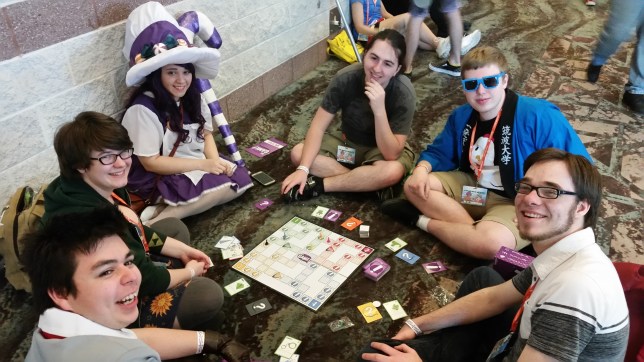
When EVERYBODY bumps into each other and falls over, it’s less embarrassing.

Two Possible Expansion Packs


If you’ve spoken to me in the past few months, or if you’ve been paying attention on social media, you are probably aware that I am designing an expansion pack to Mr. Game!

Two, actually. Since the summer of 2016, I’ve been spinning my wheels about adding a bundle of cards to the game. Tentatively titled “Mr. Trolling!” and “Mr. Strategy!”, these expansions would simply be tiny foil packages of 25 – 40 cards each, designed to be shuffled into the main deck of the base game.

Is your game too chaotic, and players feel like they can’t make any decisions? Add in “Mr. Strategy!”, which has plenty of Badges that you can use to plan your great escape.

Is your game too dull? Figured out all the best interpretations for every rule? Add in “Mr. Trolling!”, which has ridiculous cards and effects that will leave even the best Mr. Games at a loss for words.

That’s the plan, anyway. Two expansions at once is probably a stupid idea, but I just had too many good ideas for cards. If you’ve got a good idea for a card, you should stop reading and submit it to the website, already! If I’m going to consider it for an expansion, I’ll add a prototype version to the official Facebook album.


20160611_173124.jpg

Just make sure you don’t lie about the size of your crowd…

Bringing A Crowd To Kickstarter

Before I do any kind of expansion to Mr. Game!, it’s important to first check off a few boxes. I have no interest in running a Kickstarter campaign that just barely scrapes by at the end. That won’t make a profit, and it won’t help the future of the game. It will just create another hole that I need to spend a year digging myself out of.

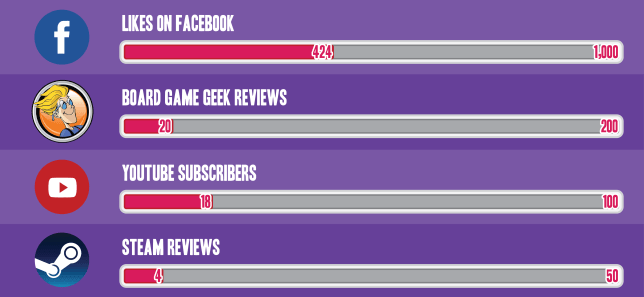
There’s a good expression when it comes to crowdfunding: You bring your own crowd to Kickstarter. That means that the 30 days of a campaign are not meant to grow your audience, but rather you should mobilize an existing group towards a specific end. Since that’s the case, I intend to hit the following social goals before I even consider launching a second Kickstarter for Mr. Game! See the image below:

GreatAgainSocialGoals-01.png

The status of the Pre-Kickstarter Social Media Goal project as of January 26th, 2017

Pre-Kickstarter Social Media Goals

  1. 1000 ‘Likes’ on the official Facebook Page
  2. 200 individual ratings on Board Game Geek, overall average rating of 7.5
  3. 100 Subscribers to the Game Revenant YouTube channel
  4. 50 Reviews on Steam, overall average Positive rating

Now you might be saying to yourself at this moment “Frank, don’t bother measuring numbers like this on social media – they mean nothing!” I agree, and that’s why the numbers are intentionally pretty high. Achieving these goals would represent a huge departure from the audience Mr. Game! has currently, even if some people end up being ‘duds’ who do not engage on social media. A larger audience means a bigger network of friends and family who will support the game, back the Kickstarter, and ensure the expansion “sells through” at a fast pace.

This is the way to make Mr. Game! great again, but I can’t do it alone! In fact, I can’t do it at all. In order to make these expansions happen, I need people in the community to take a few minutes out of their day and do me a serious favor.

The Facebook Page is the main social media hub of Mr. Game!, so if you haven’t invited your friends and family to Like it yet, do it! Play the game with them first. Show them this blog post. Then ask them to Like it and follow along. (You should Like it too!) Small businesses can’t succeed in a vacuum – it’s essential to have a dedicated fan base!

Board Game Geek is a very strange website, but immensely popular. Navigating it is a pain, but if you review the game on that site you’ll strike a serious blow against the Board Game Establishment. (Well, not really… but if you like to think of it that way then I won’t stop you.) Please make a BGG account, give the game a positive review, and tell people about your experience with the game.

The YouTube Channel is a bit of a new venture and could use a boost. It’s going to be the main hub for every game I create from now on. Gotta start somewhere!

Steam is currently hosting Tabletop Simulator and the Mr. Game! Downloadable Content bundle, but sales could be better. Solid reviews from people who own the game would really help out! Tell people about your experiences with both the digital and physical versions, perhaps highlighting the strengths and weaknesses of each.


cancer-threat-mobile-phone-use-real_16

If this overlapping mob of early 2000’s phones can do it, so can you.


Contact Me Directly

I think that’s enough navel-gazing for one blog post. But there is one more thing – if you have an idea for how I should promote Mr. Game! and my business, reach out! Message me on Facebook. Tweet me @Yoshgunn, the official Mr. Game! account @WhoIsMrGame, and my studio @GameRevenant. Email me using contact@GameRevenant.com if you feel it’s something best discussed in private.

I’m very new at this and I’m taking any and all suggestions into consideration. So, if you’ve ever thought to yourself…

  • Why wasn’t Mr. Game! at [insert show name here]?
  • There should be a video about [topic] on the YouTube channel…
  • Frank should post about [topic] instead of [other topic]!
  • Mr. Game! should be available at [insert store name here], why isn’t it?

That means you should contact me directly and tell me that! I won’t criticize your ideas or call you stupid. In fact, my reaction will probably be “oh man, why didn’t I think of that a year ago!?” and I will be forever grateful for the advice. As my friend Jack Kelly wrote about earlier this week in his blog about adversity, constructive criticism is the key to success.

So get out there, tell the world about Mr. Game!, and let’s get ready to (maybe) do a Kickstarter for this thing at some undisclosed point in the future! Wooo!


= = = = = = = = = = = = = = = = = = = = = = = = = = = = = = = = = = = =

I’m going to need your help if we’re going to make a successful Mr. Game! Expansion Pack Kickstarter happen. Let me know if you have any questions or feedback! The game’s official website is WhoIsMrGame.com, where you can purchase a copy for yourself.

Frank DiCola is the founder of Game Revenant and the creator of Mr. Game!

Where Shadows Slumber: Adversity

FRIEND. Hey Jack, what’s up? You’re usually up to something interesting – are you working on anything right now?

JACK. Hey man – yeah, we just started working on a mobile puzzle game based on shadows! Basically-

FRIEND. Mobile? People are still doing that? I thought that mobile gaming was over [and anyone who decides to make a mobile game is a complete idiot!]”


I don’t think I quoted the above conversation exactly right, but I will say that it is exactly what you do hear as a game developer when these types of conversations occur. Deciding to go into indie game development can be a big risk, and while these conversations are important, they really aren’t that much fun.

In this post I’m going to delve into the concept of adversity and how to deal with it. This will be the first in a three-part series of blogs, all about staying focused and productive.


Dealing With Criticism

Criticism is one of the most important aspects of game development, especially for indies. You need to know what people don’t like about your game, so that you can fix it. As such, people tend to be very forthcoming with their criticisms.

However, after endless hours of hard work, it’s easy for a developer to have trouble dealing with criticism. And it’s easy for a friend, intending to offer constructive criticism, to end up simply insulting or demotivating a developer.

Throughout the development of a game, us developers put a lot of thought and work into creating something we can be proud of. When someone else picks apart our creation, we often wonder – why does everyone make sure that us developers find out everything they dislike about our game?

Game development is a field that lives and dies by the opinions of players. The best way to find out what you need to change about your game is to ask your audience. And the best way for a gamer to ensure that a game ends up being good is to tell the developers what they don’t like. This relationship is a very good one, so don’t take it for granted.


Types of Adversity

How can game developers prepare to deal with adversity? By knowing what to expect.

Handling Detractors


grongus

This was an early review of the Where Shadows Slumber demo for Android.

This is the most obvious type of adversity, and the type we have come to expect. No matter how awesome your game is, there will always be people who simply do not like it, and you will always hear from them. Something about your game is not good enough for them, whether it’s too short, or the graphics aren’t good enough, or the gameplay is too simple.

“You game is a big ol’ stupid!”

– Some dude who hates your game

The best way to deal with this type of adversity is to learn what you can from it, and then to let it go. Unfortunately, it’s impossible to please everyone. You game may be made for many different people to enjoy, but you still have a target audience, and a lot of people will fall outside of that audience. If you focus too much on trying to please every person who says something bad about your game, you’ll just drive yourself crazy. Just accept that this person will probably never love your game, and continue trying to make it the best it can be for those people who will enjoy playing it.


Handling Constructive Criticism

img_2738

(Above) The  incorrect way to respond to constructive criticism.

Constructive criticism is the lifeblood of the indie gaming community, and any developer who really wants to do well is always on the lookout for it. Constructive criticism tells you what parts of your game need improvement, and it comes directly from the mouth of your target audience.

This is a very important point – I can’t tell you how many times we implemented a feature that we thought would be cool, only to find that our fans didn’t like it. Sometimes you make the wrong decision (especially when working in a small team), and constructive criticism helps you find out what things you need to change before it’s too late.

“Tell us what you hate about our game. We have thick skin, we can take it!”

– Frank, at every convention we go to

This is the easiest type of adversity to deal with, since we are constantly seeking it. This person likes your game, and they’re just trying to make it better, so they can enjoy it even more! The most important thing about constructive criticism is to always be ready for it, and to always listen to and learn from it. The player told you exactly what they want – try to give it to them!


Handling Friends Who Are Trying To Help

“You can do this, but to be more accurate, you probably can’t.”         – Barney Stinson

The third type of adversity I’ll talk about today is one that I wouldn’t really have expected, when I first went into game development, and is the main reason that I decided to write about this topic. That is the adversity that you receive from your friends.

“But wait, didn’t we just talk about that? Your friends are giving you constructive criticism, right?”

Yes, your friends are often a good source of constructive criticism. Maybe my friends are just the worst, but I’ve also noticed another, more sinister type of criticism.

“I’m only saying this because I care about you – you are literally the worst.”

– Your ‘friends’

Your friends love you, and having them in your life is awesome. However, they don’t always share your passions, specifically about game development. Many of them might think that you’re getting your hopes up and stressing yourself out for no reason. Maybe you don’t spend as much time with them as you used to. Maybe they’re just jealous of how awesome your game is. Whatever the reason, they’ll probably let you know.

I’ve heard a lot of different comments, but most of them begin with some form of “I’m saying this because I care about you…” This is the ultimate way a friend will disguise a negative comment. A lot of times you’ll hear something like “You know your game isn’t going to take off, right? I just don’t want you to get your hopes up,” or “Why are you wasting so much time on that – I mean, it’s just a hobby, right?”

Perhaps they are saying it because they care about you, and perhaps they mean well. Game development requires a lot of motivation and momentum, and hearing these things from the people who most care about you can be very disheartening. Sometimes you need to hear these things, but if you’re simply committed to creating something you can be proud of, you don’t need that kind of demotivation.

So how do we best deal with this type of adversity? To be honest, I wish I knew. The easier strategy is to simply nod along with them – “yeah, I know my game isn’t that great, but it’s a fun hobby.” This doesn’t seem fair to you, as you’ve put a lot of work into your game, but it’ll get them off your back. The other strategy is to explain to them that you’re doing everything you can to make this game a success. You’re putting a lot of work into it, and you would appreciate their support. If they have any constructive feedback, you would love to hear it.

Honestly, I think the second strategy is probably better, but as an introverted developer, I find myself utilizing the first more often. This is something I’m working on, but I think this is the type of adversity that is the most difficult to overcome. If you have any tips or thoughts about this one, we would love to hear from you!


= = = = = = = = = = = = = = = = = = = = = = = = = = = = = = = = = = = =

Hopefully this post gives you a little bit of insight into some of the types of adversity you will most likely see as a game developer, and how to deal with them. Next time I’m going to discuss another topic that I find plagues me and many other game developers: staying motivated.

Until then, let us know if you have any questions or feedback! As always, you can find out more about the game at WhereShadowsSlumber.com, find us on Twitter (@GameRevenant), Facebook, itch.io, or Twitch, and feel free to email us directly with any questions or feedback at contact@GameRevenant.com.

Jack Kelly is the head developer and designer for Where Shadows Slumber.
Mechanic Spotlight: Shadows, Part 2

Where were we before we were so rudely interrupted by my extreme laziness? In my last post, we went over the basics of how shadows operate in Where Shadows Slumber. This week, we’ll pick up where we left off, and I’ll describe the way I actually implemented shadows, and the reasons for doing so.

Last time, I described two different ways to think about objects changing in shadow. Unfortunately, I did so in a sentence that, in retrospect, looks simply confusing:

[Things] can always change when put into shadow, or they can only change when you move around the object casting the shadow, so you’re on the other side of the casting object, relative to the changing object.

Yeah, that’s no good. So let’s figure out what this means, in a way that’s a little longer, but easier to grasp. We’ll use the classic pillar / bridge problem, where the pillar is casting shadow, and the bridge is changing with that shadow.

If I walk past the pillar, the shadow will overcome the bridge. If I continue walking, the shadow will move, the bridge will be revealed, and at this point, it should have changed. This is exactly what we want.

shadowtransition

Not only is the pillar / bridge problem less violent than the trolley problem, it’s more relevant!

Now consider the scenario where I start to walk past the pillar again. The shadow overcomes the bridge again, but this time, I stop walking, leaving the bridge in shadow. Instead of continuing forward, I turn around and go back. The shadow moves, so we can see the bridge again, but we’re on the same side of the pillar as we started. Now the question arises – should the bridge have changed?

This is a very important question when considering this mechanic. Thinking about it from a ‘pure’ standpoint, of course the bridge should have changed – it was in shadow. After all, that’s the rule, right?

This was exactly my thought process, and is why I implemented the mechanic in the way I shared in my last post. The early prototype we made behaves in exactly this way. However, as I got further into level design, I realized that this is not what we want. In order for many of our level designs to work, the above scenario would need to result in the bridge not changing.

When designing levels for a game like this, there are a number of considerations to make, but one of the most important is to remember that the player will not always do what you want. I may want the player to walk around the pillar, but the player may instead decide to walk behind the pillar, and then turn around. If I need the player to end up on the far side of the pillar (for a story event, part of the puzzle, etc.), that becomes hard to accomplish with the current version of the shadow mechanic.

So, it seems that we need to update the implementation of our mechanic. The way we want it to work has more to do with what side of a shadow-casting object we’re on – the bridge can only change when we move around the pillar.

Fortunately, this is actually an easier problem than the previous one. When we think about it this way, we don’t even need to use shadows – what we’re really checking is when we pass the object. When the light (player), the blocking object (pillar), and the shadow object (bridge) are all in a row (collinear), we can simply know that the object is in shadow rather than checking. This is true when we make a few assumptions:

  • Both the pillar and the bridge are about the same size. This means that we may have to break the bridge up into a number of 1×1 ‘shadow objects’.
  • Each light involved originates from a single point (so point/spot lights, not directional lights).
  • The bridge is further away from the player than the pillar.

When all of these conditions are met, we can ignore the shadow itself, and just change the bridge when the player passes the pillar. It’s a little hard to conceptualize, but a picture is worth a thousand words!

passingshadowobject

Alright, maybe like 500…

At the moment the player passes this ‘collinear point’, we trigger the shadow object to change (note that at that moment, the shadow object will be entirely in shadow). But the shadow is just there for cosmetic purposes, like a magician’s illusion – it’s so you don’t see the trick!

As I said before, this problem is much easier to solve – every frame, we simply compare the angle from the player to the blocking object with the angle from the player to the shadow object. When those angles switch, it means that the shadow object is in shadow and should change.

In this way, we can easily keep track of when a shadow object should change. There are a few ways in which this situation can become more complicated – if there are multiple lights or blockers that should affect a single shadow object, if there are multiple shadow objects that should use a different set of lights or blockers, etc. These are all very important things, but they’re all things that can be implemented by carefully extending the system we laid out above. As such, implementing them is left as an exercise to the reader : )

There are still ways we can use the previous implementation to help out with the shadow system. There are a few cases where we might need to actually know if an object is in shadow, rather than just making the assumption that it is. Thus, our shadow system includes a sort of ‘back-up’ shadow-detection – in certain cases, we fall back on the more accurate, more expensive shadow detection we worked on in my last post.

= = = = = = = = = = = = = = = = = = = = = = = = = = = = = = = = = = = =

That finishes up our high-level overview of our implementation of the shadow mechanic – I hope you enjoyed it. Let us know if you have any questions or feedback! As always, you can find out more about the game at WhereShadowsSlumber.com, find us on Twitter (@GameRevenant), Facebook, itch.io, or Twitch, and feel free to email us directly with any questions or feedback at contact@GameRevenant.com.

Jack Kelly is the head developer and designer for Where Shadows Slumber.