Problem Solving: Design and Complexity

Game design and development is a complicated process. Creating an intricate tapestry of player interaction, incentive, and reward can be quite difficult, and you will no doubt run into trouble along the way. This is a simple fact of game development – in fact, this phenomenon represents most of the time you’ll spend working on your game. Therefore, you shouldn’t worry about it when that trouble finds you! However, an important part of how polished your game ends up, how long it takes to make, and whether or not you even get a chance to finish it is how you handle the issues you run into.

At its core, a game can be described by a set of rules which govern gameplay, and a starting game state. A match-three game, for example, can be described by the following rules:

Simple match-three rules

  1. The game starts with a grid of colors.
  2. Any three or more adjacent cells of the same color disappear, granting points to the player.
  3. If there is an empty cell, the cells above it slide down to fill in the space, generating a new cell at the top.
  4. The player may switch the colors in two adjacent cells.
  5. The game may end when the player reaches a certain number of points, or when they make a certain number of moves, or if there are no available moves, etc.

Obviously, these rules don’t encompass everything that happens in a game, and the rules get much more complicated very quickly for more complex games. These simple base rules define your gameplay, but they very quickly become more intricate as you add features and functionality. Let’s look at a few updates to our match-three example:

  • If we want to add a type of cell which can’t be moved, we would have to change rule #4 to “The player may switch the colors in two adjacent cells unless either of those cells is unmovable”.
  • If we want to add an “exploding” cell which eliminates nearby cells, we would have to change rule #2 to “Any three or more adjacent cells of the same color disappear, granting points to the player, and if one of them is an exploding cell, adjacent cells also disappear”.

The base rules handle 90% of the gameplay situations, but we have to add special provisions for exceptions of those rules. In game development (and computer science in general), these exceptions are called edge cases, and, as necessary as they are, they’re super annoying. Your code will include edge cases, and it should, but you have to be careful with them (edge cases may be considered a type of hack, which I discuss in one of my previous blog posts), and you should avoid them when possible. One of the primary ways to do that, depending on your game, is through design – rather than complicating your codebase, you can try to design your game and/or levels in such a way that you don’t need to change your code.


An Example from Where Shadows Slumber

Let’s take a look at the inspiration behind this post – a case I ran into in Where Shadows Slumber where I faced such a decision.

1-1 goal

Ominous!

At the end of each level, there’s a ‘goal’ space. When Obe steps on it, it triggers the end-of-level sequence to begin – the lights fade, Obe walks out of the scene, and then the next level loads. The question is, given the game rules, how can I make this happen? I could have added a specific code path for this case, but I realized that I could use some already-existing mechanics to create this effect:

  • The machinery behind buttons can already handle “trigger something when Obe steps on a space”, including a delay for ending the level.
  • The machinery behind Obe walking in at the start of the level allows us to redirect his movement.

This is one way of handling an edge case – try to reduce it into an example of something you already have, thus changing it from an edge case into a normal case. Now we’ve changed the ‘goal’ space into a different-looking button with a redirect space.

Now, there’s another situation involving the goal space where I was given a similar choice. In some levels, there’s a space both to the left and to the right of the goal space. This enables a situation in which the player moves onto the goal space, and then away from the goal space. This creates a problem: the end-of-level ‘button’ will trigger, the lights will dim and the next level will load, but Obe hasn’t left the scene – he’s still just standing there!

ezgif.com-video-to-gif

Well that’s not quite right…

This is a problem I can solve by changing the rules, or by changing the design. The rules for redirecting Obe’s movement only apply when he doesn’t already have a destination. In order to handle this situation, I could add a case that says “if the current node is the goal node, do the redirection”. This requires that I add code to mark a node as the goal node, and to check if the current node is the goal node. While this code would be pretty small and easy to write, it still adds to the overall complexity of the codebase. Is there a way to avoid doing so?

There is, in fact, and it’s quite easy. If we simply remove all of the places where this could happen, then we don’t have to worry it! We’re not “solving” the problem in a conventional sense – if the configuration of spaces were to come up again, the problem would still occur. However, by changing the level design, we remove any chance of that happening.

1-1 goal with boxes

I’ll have Frank make something more on-theme to fill that space

This is another way of handling an edge case – by making a small change to the level design, we’re able to avoid making changes to the codebase. This prevents our code from becoming needlessly more complex, making it easier to understand and maintain. While not every problem can be solved in such a simple way, there are many that can, and keeping an eye out for them is a great way to avoid unnecessary code complexity.


Living on the Edge

I keep talking about edge cases and code complexity like they’re bad things. But an entire game is a very complex thing – doesn’t it make sense for the codebase behind it to be complex as well?

There’s nothing inherently wrong with complexity in your code; a well-implemented cache invalidation algorithm is a beautiful thing, complex as it is. What isn’t beautiful is needlessly complex code. The logic in this code is usually hard to follow, makes assumptions, and leaves a lot of small bugs that you’re unlikely to notice right away. This is a recipe for disaster, because every time you try to make a small change, you have to wade through a swamp of half-thought-out code paths, and you end up adding more complexity just so that you don’t have to deal with the complexity that’s already there!

The biggest problem is that it’s very hard to tell the difference between code that’s complex because it has to be (good) and code that’s complex when it doesn’t have to be (bad). The way I deal with this is to try and realize when the code I’m writing is starting to become very complex. Even though I might only be fixing one bug or working on a specific part of the implementation, I try to take a step back and look at the problem that I’m trying to solve, and how I’m solving it. If the problem is a complex one (cache invalidation), then I accept that it’s gonna be a complex algorithm, and keep writing it. If it’s not a complex problem (sorting), I take another look at my code and see if there’s a better way to do what I’m trying to do. In this way, I continuously re-evaluate the complexity of my code, and whether or not I need it.

Hack

Six while loops isn’t too many, right?

I know that “I just know when it’s too complex” might not be the most satisfying answer for those of you who often run into issues of complexity. That feeling is something that you pick up as you do more and more coding, and especially as you revisit your own code – “wow, I can’t believe I wrote such stupid code”. For those who want a more concrete answer, here are some of the ‘red flags’ that I try to keep an eye out for when assessing the complexity of my code:

  • A lot of ‘if’ statements – If your code has a lot (and I mean a lot) of random ‘if’ statements (especially nested ones), then you might want to take another look at the design.
  • “I don’t know…” – If you can’t quickly and easily determine what each piece of your code is meant to be doing, your design might be too complex.
  • Guessing – If you ever find yourself just “trying things” and “seeing if they work”, it’s a clear sign that you don’t understand your code well enough. Take some time and get to know it!
  • Duplicated code – If you have the same block of code copied into a few places, you should revisit your design. Either that block belongs in a helper that you can reference, or the control flow of your code needs to be reconsidered.
  • Asynchronicity – If you’re doing anything asynchronous, you should give your code another look. I know you probably did it right the first time, but asynchronicity is one of the most difficult parts of computer science, and it’s always worth double-checking.

There are a lot of other things that you might notice about your own code and its complexity – these are just a few quick guidelines off the top of my head. Hopefully they help!


But Game Development is Fun!

Anyways, I hope I didn’t scare you away from computer science. If anything, I wanted to instill a healthy fear of needless complexity, and I hope that you’ll do what you can to reduce that complexity – whether by redesigning your code or redesigning your levels!


= = = = = = = = = = = = = = = = = = = = = = = = = = = = = = = = = = = =

If you have any questions about code complexity and how to design around it, or if you have any other questions about Where Shadows Slumber, feel free to contact us! You can always find out more about our game at WhereShadowsSlumber.com, find us on Twitter (@GameRevenant), Facebookitch.io, or Twitch, and feel free to email us directly with any questions or feedback at contact@GameRevenant.com.

Jack Kelly is the head developer and designer for Where Shadows Slumber
Hacks Versus Designs

I remember back in the day, when computers and programming were first becoming somewhat ‘cool’. Back then, the coolest thing you could be in the computing world was a ‘hacker’. Hackers were awesome renegades who could tear down opposing systems using nothing but their superior intellect. Being able to hack was one of the best skills you could have. Now, after studying and working in computer science for a while, the term ‘hack’ has taken on a very negative connotation.

When you’re writing code, there are several things that you’re aiming for. The two broadest and most important of these are:

  1. The code works – it does what you intend for it to do.
  2. The code is good – it’s efficient, understandable, and easy to use/improve.

It seems like these two things would go hand-in-hand, and for well-designed code, that is often the case. However, the road to that ‘well-designed’ code is often fraught with terrible, terrible code. So, what’s the intrinsic difference between these two goals, and how does it lead to bad code?


boolean

Hack First, Ask Questions Later

When you’re working on a large, intricate system, and you need to add something or make a change, these two goals lead to two different types of results – a hack, or a design:

  • A hack is a piece of code with only the first goal in mind – you’re just trying to ‘make it work’. You don’t want to put a lot of thought or time into the implementation, you just want it to work.
  • A design has both goals in mind – you’re spending time to come up with a good solution. You’re willing to work a little harder to end up with a more robust, long-loving solution.

Designing a solution to a task leaves you with good code. It’s easy to understand, easy to use, and easy to update. The algorithm makes sense, not just in terms of “does it do what I want”, but also in terms of “does it make sense with the theory behind it”.

Looking at these two descriptions, it’s pretty easy to see – designs are better than hacks. So why would anyone ever want to use a hack to get something done? There are a few reasons.

Designs take more time. You have to come up with a solution, consider its long-term viability, consider how it will interact with every part of your system, present and future, tweak it accordingly, and make sure that it still matches the theory of your application. A hack, on the other hand, involves simply coming up with a quick and dirty solution, and implementing it.

Designs require deeper understanding. In order to fully understand the impact of your newly-designed code, you have to completely understand the current state of your application, remember all of the assumptions you made when coding it, and ensure that your new stuff won’t interfere with any existing stuff (Note that this is much harder to do on a larger team, as there are areas of the code you may not be as familiar with).

Designs are often much larger in scope. When designing a solution, it will often involve creating a ‘system’ or ‘engine’ of sorts. Not only does this take longer to think through and implement, but it also opens the door to a lot of subtle interactions between systems. Hacks are (usually) much more localized – “I’m gonna make this hack here, but I won’t use it in other places”.

You don’t want to spend a lot of effort on code that will be replaced eventually. This is really just a combination of the above points, but it’s an important reason why hacks exist. If you have to update a small piece of code, but you know that you’re going to come in and change the whole thing next month anyways, why would you put a lot of time and effort into designing a solution when a quick, hacky fix will do the trick?

Looks about right Cropped

This is what happens when you leave hacks in your code!


Here’s An Example

Let’s say you’re you’re working on a pretty simple game in a pretty simple game engine, using a pretty simple programming language (hint: this means I’ll be using pseudo-code rather than real code). You’ve got your character on the screen, and you want to make him move back and forth along some flat ground whenever you hit an arrow key. You might start out with something like this:

if (keys.leftArrow) {
  dudeGuy.position.x -= 10;
}

if (keys.rightArrow) {
  dudeGuy.position.x += 10;
}

Pretty simple and straightforward – if you’re pressing the left arrow key, move your dudeGuy to the left, and if you’re pressing the right arrow key, move him to the right.

So, you use this code for your movement, and it works, and you continue working on your game. Then, suddenly, you have an epiphany – what if your dudeGuy could jump? You add a variable and hook it up:

int jumpingTimer = 0;

...

if (keys.spaceBar && jumpingTimer == 0) {
  dudeGuy.position.y += 30;
  jumpingTimer = 3;
}

if (jumpingTimer > 0) {
  dudeGuy.position.y -= 10;
  jumpingTimer--;
}

As you continue making your game, you design some levels where you realize that you want the gravity to be less strong, so you have to account for that:

float gravity = 10;

...

if (keys.spaceBar && jumpingTImer == 0) {
  dudeGuy.position.y += 30;
  jumpingTimer = 30 / gravity;
}

if (jumpingTimer > 0) {
  dudeGuy.position.y -= gravity;
  jumpingTimer--;
}

Then you realize that your back-and-forth movement looks pretty choppy, so you decide to add some ‘smoothing’, so your dudeGuy speeds up and slows down:

int movingLeftTimer = 0;
int movingRightTimer = 0;
int jumpingUpTimer = 0;
int jumpingTimer = 0;
float gravity = 10;

...

if (keys.leftArrow) {
  if (movingLeftTimer < 3) {
    movingLeftTimer++;
  }
} else if (movingLeftTimer > 0) {
  movingLeftTimer--;
}

if (movingLeftTimer > 0) {
  dudeGuy.position.x -= 10 / (4 - movingLeftTimer);
}

if (keys.rightArrow) {
  if (movingRightTimer < 3) {
    movingRightTimer++;
  }
} else if (movingRightTimer > 0) {
  movingRightTimer--;
}

if (movingRightTimer > 0) {
  dudeGuy.position.x += 10 / (4 - movingRightTimer);
}

if (keys.spaceBar && jumpingTimer == 0) {
 dudeGuy.position.y += 30;
 jumpingTimer = 30 / gravity;
}

if (jumpingTimer > 0) {
 dudeGuy.position.y -= gravity;
 jumpingTimer--;
}

And,  before you know it, with only a few changes to what we were trying to do, we end up with a piece of code that’s incredibly messy, almost impossible to understand, and prone to bugs and off-by-one errors. Honestly, I just wrote this thing, and I have no idea what it’s supposed to be doing.

Now, this example is a bit of an esoteric one, just to prove a point. However, it is definitely not the worst code I’ve ever seen (or written), and that’s saying something. What should we have written instead? Well, if you couldn’t guess, the above code is an example of a hack (or a number of hacks put together). Rather than examining what it was we needed in the long run, we repeatedly implemented something that did the job in the short term. So, let’s make a design for this use-case, and think about what we need overall.

We want to be able to move left/right, jump, have different values for gravity, and have smoothing on our movement. This sounds a bit like actual physics, so lets steal some important concepts from them – acceleration and deceleration. We’ll determine some rules that match our design, modify the dudeGuy’s acceleration in each direction based on those rules, and then move his position all at once:

float maxSpeed = 10;
float acceleration = 3;
float jumpAcceleration = 10;
float gravity = 3;
float friction = 5;
float minY = 0;

float vx = 0;
float vy = 0;

...

// If the left arrow key is down, accelerate to the left
if (keys.leftArrow) {
  vx -= acceleration;
}

// If the right arrow key is down, accelerate to the right
if (keys.rightArrow) {
  vx += acceleration;
}

// If the spacebar is down and the dudeGuy is on the ground, accelerate upwards
if (keys.spaceBar && dudeGuy.position.y == minY) {
  vy += jumpAcceleration;
}

// Accelerate downwards for gravity
vy -= gravity;

// Decelerate for friction
if (vx > 0) {
  vx -= friction;
} else if (vx < 0) {
  vx += friction;
}

// If we're going to fast to the right, slow us down to the max speed
if (vx > maxSpeed) {
  vx = maxSpeed;
}

// If we're going to fast to the left, slow us down to the max speed
if (vx < -maxSpeed) {
  vx = -maxSpeed;
}

// Update the dudeGuy's position based on our current velocity in each direction
dudeGuy.position.x += vx;
dudeGuy.position.y += vy;

// If the dudeGuy is below the ground, move him up to ground level
if (dudeGuy.position.y < minY) {
  dudeGuy.position.y = minY;
  vy = 0;
}

While we have a similar number of lines of code here, it’s much clearer what’s happening on each line. Every block serves an easy-to-understand purpose, and making changes to the ‘rules’ of movement is very easy. There are a lot of different ways to improve this code, depending on your game’s overall design, but this is a decent, and most importantly simple, place to start.

Another important feature of this piece of code is that it is well documented. Every block is pretty small, but it still has a comment describing the purpose of the block. This is an extremely important part of programming in the context of larger systems – you want to make sure that you (or anyone else) can quickly understand what your code is doing, especially in complex cases. Even though some complex logic might seem simple to you, it’ll definitely seem more difficult when you come back to it in 6 months!


A Necessary Evil

Unfortunately, hacks are a necessary evil. While I would love to only ever have to deal with and implement beautifully-designed code, that world doesn’t exist. There’s always a timeline, there are always changing assumptions and new features, and there’s always someone who wants it to be finished yesterday. Inevitably, you’re going to have to write some code quickly, implement a feature that’s likely to change, or come up with a simple ‘solution’ to a difficult problem. In cases like this, you’re forced to use a hack.

Hack

I mean, it works… technically…

It’s not all bad, though. While hacks in general are pretty bad, they can be manageable if you make sure to use them correctly. In fact, I would be willing to bet that any system currently in production (of a certain size) contains quite a few hacks. There are certain qualities that hacks can have which make them a little bit more manageable, and you should try to aim for them whenever you find yourself implementing a hack:

  • Understandable – It’s important that, whatever your hack is, anyone else looking at the code can understand what you were trying to do, and how your hack works. This means leaving a lot of comments around your hack, as well as simplifying the logic as much as possible.
  • Localized – If you have to hack something in, you want it to only be in one place. Every time that code path is used, there’s a chance that something will go wrong. If your hack only touches a small part of your system, then its negative effects will be much less noticeable. This means that frequently-used code paths should never really have hacks in them, while hacks in rarely-used code paths are more acceptable.
  • Known – This is, to me, the most important part of making a hack. If you hack something in and then forget about it, when your system starts failing, you won’t know where to look. If you make sure you remember it (by writing it down somewhere and then telling every person you know), then you’ll know where to look if something goes wrong. On top of that, you’ll always have that hack in the back of your mind, so you’ll be more likely to think of a good design to replace it.

If you follow these guidelines and make sure to try to go back and fix them, then putting hacks into your code won’t end up destroying you.

I hope this was helpful to those of you just starting out in game development – or anything which involves designing complex systems! For those of you who already know a little something about computer science, I hope this at least reinforced your burning hatred of hacks!


= = = = = = = = = = = = = = = = = = = = = = = = = = = = = = = = = = = =

If you want to know more about how to deal with hacky code, or what kind of hacks are in Where Shadows Slumber so that you can exploit them, feel free to contact us! You can always find out more about our game at WhereShadowsSlumber.com, find us on Twitter (@GameRevenant), Facebookitch.io, or Twitch, and feel free to email us directly with any questions or feedback at contact@GameRevenant.com.

Jack Kelly is the head developer and designer for Where Shadows Slumber.

Dream Team

As Frank mentioned a few weeks ago, we’re getting closer and closer to the release of Where Shadows Slumber in Spring 2018, and as such, we’re going to try to take on a bit more of an active role in terms of publicizing the game. To that end, I’m going to take some time today to answer a question I’ve been asked a few times, that’s very vaguely related to the topic of publicity. “If you guys were to start another indie game development project,” they ask, “how would you want to expand your team? What skills and responsibilities would you want from your new team members?”

This is an excellent question – pursuing a decently-scaled project requires a lot of forethought and planning, and none of it is more important than designing your dream team. After all, you’re going to be working with these people for a while – so what does your dream team look like? The best way to answer this question is with experience. I’ve been working on this project on a two-person team for over two years now. What’s my dream team?

a-team_1

I will never cave and get Photoshop or something else “professional”!


In The Beginning…

When Frank and I first embarked on Where Shadows Slumber, we felt like we already had a pretty good team. Our personal dynamic was good, and we knew that together we had the set of skills that would be required – I would do the programming and design, and Frank would do the art and sound. Boy were we in for a rude awakening!

You see, for our first project, SkyRunner, we did the same thing. We built and released it, and it never really felt like our team had a gap in skills. It didn’t do so well, but we viewed it as a learning experience either way, so we never felt that we had failed to do anything in particular. When planning Where Shadows Slumber, we tried to do the same thing – design/programming, and art/sound. What we didn’t realize was that there was a huge gap in our skillsets. One of, if not the most important skills was something that we simply didn’t possess. We’ve been managing okay without it, but everything would be going a lot smoother if we had thought about it up front.


Where We Are Now

Before I get into the things that we don’t have, let’s talk about what we do have. We have a very lean, very agile team, with pretty strong design, artistic, and programming skills. There hasn’t really been a point when I’ve thought “man, I don’t think I’m gonna be able to implement this” or “wow, I really wish Frank were better at art” or anything. These are our strong points, and these are the things that we’ve consistently done well throughout development. I don’t think we need to do anything to improve on these skills at the moment.

On the flip side, there are a couple of areas where we are lacking. You’ll notice that I previously listed ‘sound’ as one of the tasks, but I didn’t mention it above. That’s because neither of us has any training or experience in sound design. Frank heroically took on the sound for the demo, since it sort of feels like a more artistic endeavor, but we quickly realized that we would need someone else to do the sound design for Where Shadows Slumber if we wanted it to have a real professional sound.

However, sound isn’t the thing that we were missing at the beginning. We’ve been looking for sound people, and we’re confident that we’ll be able to incorporate great sound design into the game. No, there’s something else, a huge blind spot, something that could potentially destroy us all and leave us with nothing, something that we never realized we needed, but can’t live without. There’s one more task that encompasses everything we’ve already talked about, and is perhaps more important than all of them put together.


Publicity!

A successful game is one that a lot of people download. The idea is that if your game is really good, people will download it. Unfortunately, this idea doesn’t always pan out – in order to get people to download your game, you need to give them some reason to. This is where a marketing and publicity expert really helps.

press

“Our game really speaks for itself.”

This can be a tough pill to swallow – paying someone who may literally never contribute to the actual game itself can feel pretty awful. Despite this, your publicity expert will probably end up being the most important person on your team.

Think of this person as a salesman, helping you sell your product. It doesn’t matter if you have a billion units of the best product on the market – if you don’t have someone to sell it for you, you’re not going anywhere. Infrastructure like the app stores make this a little easier, since you can publish a game yourself, but you still need someone advocating for you and getting people to download the game.

We don’t have the experience or know-how to actually do this. It seems easy – just talk to people, tell them about the game, take any chance to promote it. But the reality is much more difficult. In reality, it’s a full-time job. Talking to bloggers, reaching out to potential publishers, doing interviews, even writing blog posts, all of it adds up to a lot more work than we had anticipated.

In the same way that your game’s name is the first thing people will see about your game, any efforts you make at publicity – ads, going to shows, posts on Facebook – are going to be right up there in your first impression. Why wouldn’t you do everything you can to make sure you make the best first impression possible? It doesn’t matter how great your game is if no one feels like they want to play it!


“Doesn’t Play Well With Others”

Getting back to the question at hand – what would I take into account when picking out my DREAM TEAM?

Well, clearly, more people working on any aspect of the game means that the work will be done faster, right? While this is true, it’s also subject to diminishing returns. This means that two people doing the job will get it done faster than just one, but not twice as fast. In the same way, the third person on the job adds even less.

This effect is compounded by the fact that coordinating the implementation of a complex system is a tricky business. If I’m the only one working on my game, then I completely understand the whole system, and I know what changes I need to make and how they will affect the rest of the game. As soon as someone else is involved, we each have to coordinate all of our changes and work to understand the whole system. This overhead can slow things down quite a bit, to the point where it seems like it might be more efficient if just one person were working on it. You’d have to ask Frank, but I assume the same thing goes for coordinating artistic styles and assets.

how-complex-systems-fail

“Alright, new guy, here’s our system. It’s really pretty simple…”

Now, it probably sounds like I’m a crotchety old programmer who refuses to change or take a second opinion on my work. I like to think that this is not the case – I work with a handful of other programmers every day at work, and we do awesome stuff. The difference is one of scale, timing, and goals:

  • Where Shadows Slumber is a small enough project that one programmer can conceive of and manage the entire system. If I were working on a bigger project, you bet I’d want more programmers, just so that we could wrap our collective head around the tasks at hand.
  • We are nearing the end of development for Where Shadows Slumber. There’s still a long time and a lot of work left, but we’re about 80% of the way through development. Bringing someone on now would require spending a lot of time bringing them up to speed. Since there’s so little time left anyways, adding another programmer might actually cost us time, rather than save it.
  • As the only programmer and head designer for Where Shadows Slumber, I think of it as my baby, my brainchild. When working on it, I have very specific ideations and goals – hiring another programmer would mean there’s another person with their own ideas and goals. If they don’t line up with my own, then we’re gonna butt heads a lot throughout development.

Hopefully these points do a good job of explaining why I’m still the only one doing any programming work on Where Shadows Slumber. If I were to start another project, these are the things I would think about when hiring a programmer.


The DREAM TEAM

DREAM Team

Dreamin’ of the Dream Team

So, if it wasn’t obvious from everything above, my first addition to the team would be a professional, dedicated marketing and publicity person. Alongside that, I would want a sound designer – which, fortunately, we are actually working toward.

Those two roles, in addition to Frank and myself, would put us in a pretty good place, in my opinion. If I were to continue expanding the team, my next move would probably be to get another artist and programmer to help with the heavy lifting. The best way to avoid diminishing returns, I think, would be to divide the work into discrete parts – for instance, the art could be divided into the art for the game itself, and the cutscenes. If I were to bring on another programmer, I would want someone with expertise in graphics and aesthetics, since those are my weakest areas.

So, if you’re looking to put together your own dream team, my recommendations are to make sure that you don’t overload any one person, and to definitely, definitely not underestimate the value of a dedicated publicity expert. Otherwise you’ll end up posting blogs full of crappy MS Paint art and thinking “Eh, it’ll be fine”.


= = = = = = = = = = = = = = = = = = = = = = = = = = = = = = = = = = = =

If you want to know more about how our team is put together, or are curious about building your own dream team, feel free to contact us! You can always find out more about our game at WhereShadowsSlumber.com, find us on Twitter (@GameRevenant), Facebookitch.io, or Twitch, and feel free to email us directly with any questions or feedback at contact@GameRevenant.com.

Jack Kelly is the head developer and designer for Where Shadows Slumber


The Name Of The Game

As you (probably) know, Frank and I have been working for a while on a certain game-development project. And, as you also (most likely) know, the name of that project is Where Shadows Slumber. For as long as any of you have known about it, that’s what we’ve called it, so it might seem strange to think of calling it something else at this point. But the name wasn’t always Where Shadows Slumber – for quite a long time, our game didn’t even have a name. How did we get from there to here?

When I first came up with the idea for the game and we started on the proof-of-concept, we didn’t have any particular name in mind. We weren’t thinking about it at all, and we didn’t even have an idea of what kind of name we might want. That apathy followed us through the early phases of the game, up to the point where we started going to smaller events, showing it off to people, and getting feedback. We discussed different naming options, but we never considered it a huge priority, and didn’t dedicate much time to it. Before too much longer, we came to the realization – we need a name for this thing!


Why Do You Need a Name?

We were just getting started with a new, unknown game, and, against all odds, it was actually going well! People seemed to really enjoy playing our game. They seemed interested in our process as a small team. We had been perfecting our ‘pitch’ at every event we went to, and we know exactly what to say to people when we showed them our early prototypes. That’s when we realized the mistake we had made.

People liked the game, and they wanted to know more about it. They wanted to hear about updates, they wanted to know when it came out. The problem was, the game didn’t have a name – how can someone keep up with it if there’s no name to search by? That was when we stopped messing around. Making a game is hard, and making a successful game involves making the correct decision at every point in the process. This was a place where we had screwed up, but we resolved to fix that mistake immediately, and I think that our fast action was an excellent decision that did a lot to move us toward success. The decision we made was to meet up in person the following week. We would sit down and figure out a name, and neither of us would be allowed to leave until we had decided on one.


What’s In A Name?

Now, choosing a name is a surprisingly difficult thing to do. The biggest hurdle for us, I think, was the dedication that it implied – once you pick a name, once people start using it, you can’t really go back. What if we chose wrong?

whatsinaname

MS Paint forever!

While this was a scary proposition, it was also one of the things you want most out of your name. You want people to remember it and recognize it – you want it to last, and you don’t want to go back. Which just means you have to be that much more careful about choosing it. So lets look at all the things you want from your chosen name.

Recognition – The most important part of your name is that people associate it with your game. For us, when people think of the words Where Shadows Slumber, we want them to think of our game, and only our game. This is associated with having ownership over the name – nothing else is named in a way that’s too similar to Where Shadows Slumber. Take my name for example – Jackson Kelly. Go ahead, give it an image search, I’ll wait.
Do you get a bunch of pictures of my beautiful face smiling back at you, or a bunch of guitars? That’s right, the name Jackson Kelly is already ‘owned’, to some extent, by a guitar company. If I were choosing a name for a company or product, I definitely wouldn’t choose Jackson Kelly, because people (and Google) already associate it with something else.

“Pre-loading” Information – When people sit down and play your game, they won’t always know what to expect. There are some people who aren’t part of your target audience, and they might not like your game. Some games require the right mood or mindset. These are all good examples of how your game’s name can “set the mood”. If your game sounds like a puzzle game, then puzzle gamers will know that it will be good for them. If your game sounds like an endless runner, people will know what to expect. This leads, perhaps even subconsciously, to people more often playing your game when they’re interested in the style of the game, and when they’re in the mood for it. This also applies to people following your progress and keeping up with your development.

Telling a Story – Every game has a narrative of some sort – not necessarily a story in the conventional sense, but something you want your players to experience, outside of the mechanics themselves, when they play your game. For a game like Where Shadows Slumber, this is a literal story – something is happening in the world of the game, and the player gets to watch it happen. Other narratives aren’t so straightforward; take Candy Crush, for example. I’ve never played it, but I assume there isn’t really a huge storyline. Rather, what you want the user to experience are the rules of the candy world, and why the player should be connecting the candies.

Whatever the narrative, everything about your game should speak to it, should play a part in making it happen. The name, as the first part of your game users will interact with, is a vital piece. It’s where the journey begins, and you want to make sure that it helps tell your story.

Representing Your Game – Every part of your game should be great, but the most important part of your game is the beginning – can you get a user “hooked”? The name of your game is the first part of your game a potential user will experience, so it should, arguably, be the best part of your game. If you clearly didn’t put a lot of thought into the name, how can people trust that you put any effort into the game itself? [Editor’s note: see “Mr. Game!” for reference] The name is part of the game, and it should be treated as such.


How We Came Up With the Name

As I mentioned earlier, the way we came up with the name was to have a few rough ideas in our heads, and then to sit down and get it all done in one session, cagematch-style. Perhaps this wasn’t the most efficient way to get this done, but it stopped us from dragging our feet, which had been the biggest problem. So, we met up at 10 am on a Saturday, and got into it!

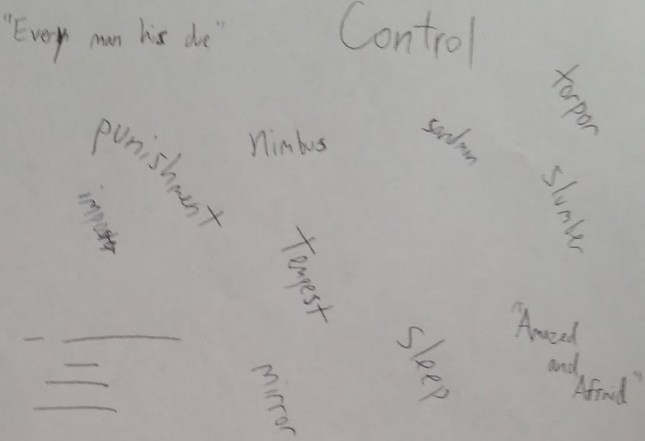
naming5

A spattering of words and concepts we considered using.

The first thing we did was to brainstorm – not for names, but for emotions. People buy most of their entertainment products based on emotion, and games are no different. What emotions do we think players will feel while playing, and what do we want them to feel? What kinds of emotions will motivate them to buy it and to keep playing it? By answering these questions, we started to figure out the tone our name should have. The emotions we decided to shoot for, to various degrees, were mystery, fear, suspense, and hope.

Once we had some emotions, we started to focus on the actual content of the name. Our name should be indicative of the things in the game, and, in particular, of the story players will find within. What are our main mechanics and story points? What words can we find for those things that fit within the emotions we chose? Again, we’re not thinking about actual names yet (for the most part), but just building up a collection of words. We ended up with quite a few, but some of the major ones were umbra, nimbus, slumber, wraith, and plenty of others.

After that, we finally got started on actually choosing a name. We tried to combine the words we had come up with into sensible, interesting names. We came up with quite a few, decided on our top four favorites, and made a little bracket. We discussed each of the names at length – what will people think, will it help us connect with players, are there other games with similar names – and eventually narrowed the search down to Where Shadows Slumber!

naming4

The final four!

This whole process took upwards of eight hours. It was an exhausting day, but I think we ended up with a pretty good name at the end of it all.


Aftermath

When we first decided on the name Where Shadows Slumber, I was pretty apprehensive, and I think Frank was too. We didn’t want to commit to a name that might not have been 100% perfect. That said, we knew we had to make a decision, so we did.

In the end, I’m really glad we settled on Where Shadows Slumber. I think the name does a lot to describe what our game will be like, we have good ownership over the name, and it really just seems to fit. It was a heck of a process, but I think we made the right choice at the end of the day!


= = = = = = = = = = = = = = = = = = = = = = = = = = = = = = = = = = = =

If you want to know more about our naming process, feel free to contact us! You can always find out more about our game at WhereShadowsSlumber.com, find us on Twitter (@GameRevenant), Facebookitch.io, or Twitch, and feel free to email us directly with any questions or feedback at contact@GameRevenant.com.

Jack Kelly is the head developer and designer for Where Shadows Slumber.