
Where Shadows Slumber at PAX!

The Where Shadows Slumber team has just returned from our biggest event yet. That’s right, this past weekend was PAX East! If you’re just starting to read this blog because you found out about us at PAX, then welcome!

PAx2

An awesome sign for an awesome show

For those who don’t know the details, we were accepted for the PAX East Indie Showcase, which showcases the “best indie [mobile] games you’ve never heard of”. As Frank mentioned when we first found out, we were totally honored to have been chosen, and the showcase really delivered. It was a wild weekend, and I’m here to tell you all about it!


What Happened?

We got to the convention center early on Friday morning, and it totally blew away our expectations. Despite knowing the scale of the event, it didn’t really hit us just how big it was, and that was just the main Expo Hall. We set up at our table, and before we knew it, PAX East had begun!

PAX3

Even this shot doesn’t do justice to the size of the hall

We spent the next eight hours showing off Where Shadows Slumber, talking to hundreds of people about the game, getting a ton of feedback, and completely losing our voices in the process. We’ve done this a lot in the past, but it’s always very refreshing to see new people playing our game. It just feels great meeting people and getting our game in their hands.

Once the main expo floor closed at 6 pm, we took some time to catch our breaths – but before we knew it, we were informed that the members of the Indie Showcase were going to be putting on a panel!

Despite all of the awesome things that happened this weekend, I think the panel was my favorite part. Since I do game development as a side project to my actual job, and I haven’t made any money from it, I never really consider myself to be an ‘expert’ of any sort. It was incredibly validating to have people seeking my advice, and I was surprised to find that I had good answers for (most of) their questions. It’s almost as though I’ve been working on indie games for the past three years or something.

After a passable Boston meal (what’s with all the seafood?) and an almost-full night’s sleep, we were back and ready for more! Saturday is always the busiest day at these conventions, and PAX did not disappoint. From the opening at 10 to the closing at 6, we consistently had a full booth, which was awesome. Fortunately, we didn’t have any obligations on Saturday night, so we hung out with some friends before heading back to the hotel early, in preparation for daylight savings time.

We had been taking Uber to the convention center on Friday and Saturday, but since we were leaving on Sunday, we decided to drive in from the hotel. Apparently, a lot of other people had the same idea, and Frank ended up sitting in traffic for over an hour; I ditched him and walked the last mile, and I was still late.

Despite the inauspicious start, Sunday was a great day too. One of the biggest problems with these shows is that we’re at this awesome event, but we spend the whole time at our own booth. It’s great telling people about Where Shadows Slumber, but it’s nice to see some other stuff. Fortunately, our web developer, Caroline, worked the booth with us for two hours or so, so Frank and I took turns exploring the expo floor. There were a lot of awesome games, and I still wish we had had time to see more of them!

After a great three days, we packed up and headed home! The weekend was incredible, and it felt so good to share it with our fellow indie game developers and show off Where Shadows Slumber.


What Did We Learn?

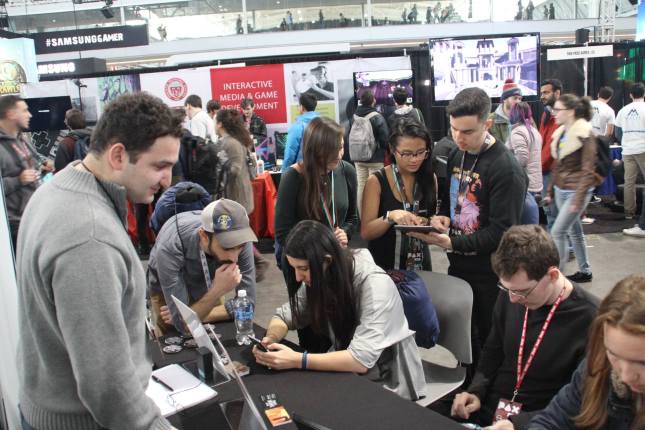
The main thing we learned from this show was that, while people may say less is more, in reality, more is more. This was the biggest PAX East ever, and it was definitely the biggest show we’ve ever been to. To be honest, we really weren’t ready for the scale. We brought five test devices and no power strip, which led to some battery problems toward the end of the day.
PAX1

With only five devices, we often had people watching and waiting for their turn!

The devices and the batteries weren’t the only things we didn’t have enough of. We brought 400 drop cards and 300 Where Shadows Slumber buttons, but we didn’t bring nearly enough. We only had a few business cards left when Sunday started, and we were out of buttons halfway through the day. If we had to do it again, I would make sure we brought a lot more – it’s better to have some left over than to leave anyone empty-handed.

Other than that, the other lessons were things we’ve learned before, but they’re still worth mentioning:

  • Bring hundreds of cough drops – continuously talking to people over the ambient sound of a convention for eight hours a day is a real strain on the voice. I went through almost two bags this weekend.
  • Don’t expect to get anything done – for some reason, I always assume I’ll be able to do some work after the convention ends for the day. Between finding food, getting back to the hotel, and planning for the next day, there’s never time for anything else.
  • Daylight savings time is the worst – yeah, it started this past weekend. Sleep is the most valuable commodity at a convention, and it seems totally unfair that we had to lose an hour of it.
  • Plan ahead as much as possible – we had a lot of trouble finding food on Saturday night, because every restaurant in the area was completely booked. Frank has mentioned it before, but I want to mention it again – plan ahead!


_Extra

What’s Next?

I definitely consider PAX East to have been a success, which is a good thing – it’s probably the last big event we’ll be doing for a while. Everyone really seems to enjoy our demo, but they also want the full game, and that means that we have to actually make it! So, the next thing on our schedule is to simply get to work and start putting Where Shadows Slumber together. There are really four big things going on in the immediate future:

  • Cutscene – The final step in creating the demo is to give you all a taste of the storyline. Every show we go to, people ask about the game’s story. As of yet, the demo does not contain any discernible storyline, but Frank is working hard to change that. We’re planning on adding a short cutscene to the end of the demo, which will server as a little teaser for the kind of story you can expect to see in the full game.
  • Testing – Over the last two months, we have designed all of the levels for the final game. However, we don’t know if the players will like our levels, and the best way to find out is to ask them! So, we’re going to be creating very basic versions of the levels we have planned, and send them out to our dedicated volunteer testers to tell us what they think! If you want to sign up to be a tester, simply let us know – you can email us at contact@gamerevenant.com, or send a private message with your email to the official Game Revenant Facebook Page.
  • Art – One of the most important parts of Where Shadows Slumber, I must begrudgingly admit, is the art. As such, we are going to be putting a whole lot of work into the art for the final game! The levels we send out to our testers will not have any art on them, since that’s the part that takes the longest. Once we know that the design of a level is pretty good, we’ll start putting some beauty onto it!
  • Refactoring – This is kind of boring to you non-technology folks, but it’s still important. As projects advance, a lot of technical debt and scope changes cause codebases to become a little unwieldy. Right now, Where Shadows Slumber is a house carefully constructed out of sticks; it’ll stay up as long as we don’t blow too hard. So, in the coming months, I’ll be working hard to redesign the code into a strong mansion of stone (or whatever mansions are built out of) that will serve for a full game.

Aside from these main four tasks, we will of course be updating this blog and trying to keep up on social media. We might also swing by a few smaller shows, but we don’t have any plans bigger than that for the next few months.

A few weeks ago, a fan of the game requested that my next blog post touch on the technical side of our process. As much as I wanted to do that this week, we really felt the need to talk about PAX – it was an awesome whirlwind of an experience, and we wanted you to know all about it! But fear not; I’ll be back again next week with a deep dive on one of the most important and most technical parts of Where Shadows Slumber – the shaders.


= = = = = = = = = = = = = = = = = = = = = = = = = = = = = = = = = = = =

Were you at PAX East 2017? Tell us about your experience in the comments below! You can find out more about our game at WhereShadowsSlumber.com, find us on Twitter (@GameRevenant), Facebook, itch.io, or Twitch, and feel free to email us directly with any questions or feedback at contact@GameRevenant.com.

Jack Kelly is the head developer and designer for Where Shadows Slumber.

3 Things I Learned at GDC 2017

I’ve just returned from a whirlwind trip to this year’s Game Developers Conference (GDC), and I have a lot to tell you! Unfortunately, most of what I learned is top secret. You hear a lot at these conventions, so between secret news and talks with undisclosed mobile publishers there isn’t a lot I can disclose. More on that later this year…

But I can certainly reveal my impressions as a first-timer to help you out if you’re planning on going to GDC 2018. Here are three things I learned my first time at GDC!


Calendar with pushpins

Lesson 1: Schedule Meetings Months Ahead of Time

My number one priority at GDC 2017 was to talk to someone from the App Store about Where Shadows Slumber. My number two priority was to talk to someone from Google Play. Specifically, I’m looking for the people that make promotions and “features” happen. Being featured on an app marketplace can sometimes be the difference between relative obscurity and worldwide fame. It’s that important.

Certainly it can’t be your only strategy, but it’s at the top of my list. Sadly, I failed! Since I was so late to the game (I only found out about GDC when two people mentioned it at MAGFest 2017 earlier this year) I never scheduled times to meet with them. Naively, I assumed there would be some kind of Apple booth and I could meet them there.

No way. Although the major players (PlayStation, Oculus, Facebook, Microsoft, Unity) had large presences at the show, Apple did not have a booth. They probably assume they would just get inundated by indies and it wouldn’t be worth the expense. If you wanted to talk to them, you had to get on their calendar months in advance. They met with business partners in secret rooms during the show, protected under heavy guard. The same is true for Google – they had a booth, but it was specifically to show off Daydream, their mobile VR peripheral. The Google Play team was nowhere to be found.

I learned the hard way – don’t make my mistake! It’s crucial that you do your homework ahead of time and get on the calendar of a major player like Apple, Google, Nintendo, or whoever you want to meet. Don’t leave this stuff to chance!


20170303_101342

GDC talk about Chinese localization pitfalls, given by Jung-Sheng Lin of Taiwan.


Lesson 2: The Talks Are Great, But You’ll Get Tossed Out

I went to GDC primarily to make connections in the industry. I wasn’t expecting to enjoy the seminars as much as I did. It turns out there are a lot of talks, panels and seminars at GDC and they run the full week. (I arrived on Wednesday, since I was mostly concerned with the Expo – but there are talks and parties beginning on Sunday) The lectures were great! I enjoyed pretty much every one that I went to. The panels weren’t as interesting as the talks because less work went into preparing them. But overall, I was impressed.

One thing bugged me though. I should have seen this coming, but when you buy a pass for GDC you’re effectively selecting what access you’ll have during the show. They have all kinds of “tracks” – Art, Music, VR, All Access, Mega Golden God Status, etc. I got an Expo Pass, which is the cheapest option. This lets you into the Expo and a small smattering of talks.

What this meant was that often I would see a talk advertised (“Nintendo Reveals All About Breath of the Wild!”) and get really excited for it only to be turned away at the door. The paper pocket guide doesn’t warn you about the access required for a talk, it just says where the talk is and who is giving it. To see a filtered view, you need the app. Once I filtered the talks available by the Expo Pass using the GDC app, it become clear that there really wasn’t too much I was interested in. Fortunately I snuck into at least one restricted talk (it was about early access and Ark) and the talks I was able to get into were pretty good. Still, it’s a bad feeling.

So, again, plan ahead! Before you buy a badge, look at the talks available. Filter the list. Ask yourself – are the seminars worth the price jump from $299 to $999? If so, take the plunge. You’ll appreciate getting the access. Otherwise, just deal with the consequences and don’t be surprised when ushers show you the door.


20170307_134433

Lesson 3: Don’t Take No For An Answer

The theme of the first two Lessons is quite clear: plan ahead. Having said that, I should also mention that just because you didn’t plan ahead doesn’t mean you shouldn’t muscle your way in anyway.

Rules only matter if they’re enforced, right? Once they stop being enforced they might as well not even apply. Although I don’t believe this is true when it comes to objective morality (don’t go burning down houses because you think you’ll get away with it), it certainly works when it comes to event admissions.

For example, I went to the Big Indie Pitch at GDC 2017 after some urging by Craig Barnes (I owe you one, man!). This is a pitching contest where you show your mobile game to publishers and industry professionals. You get 4 minutes with 5 different groups each, and they judge your game based on its aesthetics, mechanics, marketability, and overall quality. But I never formally applied for the contest because I missed the submission cut-off by one day. Feeling dejected, I almost didn’t even attend! It was 3 pm on a Thursday, I was already exhausted, the event wasn’t close to the convention center, and I very nearly bailed to go to other events instead.

Something told me I’d regret it if I didn’t at least show up, so I took an Uber over. As the event began, I begged the event coordinator Simon Drake of Steel Media to put me on a Waitlist. If people didn’t show up, I could take their slot! There were four others like me so Simon agreed, and to our surprise the Waitlisters were given a chance at the tail end of the contest to make our case to the judges. (OK, this isn’t really “muscling”, more like “pleading”… but you get the point!)

To my utter shock, Where Shadows Slumber received third place at the Big Indie Pitch! Jack and I now have $1,000 in marketing money to use on any of Steel Media’s owned platforms, and we’ll put it to good use. Another awesome thing: the second place winner, Louard of Suzy Cube, was also on the Waitlist! The moral of the story? Plan ahead, and plan for everything.

Then, expect your plans to go wrong, and don’t give up when they do!


I’m going back to GDC next year for sure. We may exhibit at the show, or just walk the show floor. I definitely want Jack to see this, because it’s an awesome experience. Where Shadows Slumber will hopefully be commercially available by GDC 2018 so the timing should be perfect… but you know what they say about plans.


= = = = = = = = = = = = = = = = = = = = = = = = = = = = = = = = = = = =

Were you at GDC 2017? Tell us about your experience in the comments below! You can find out more about our game at WhereShadowsSlumber.com, find us on Twitter (@GameRevenant), Facebook, itch.io, or Twitch, and feel free to email us directly with any questions or feedback at contact@GameRevenant.com.

Frank DiCola is the founder of Game Revenant and the artist for Where Shadows Slumber.
Heading to GDC 2017 Today!

As I type this, I’m packing to go to GDC 2017 – The Game Developers Conference at the Moscone Center in San Francisco, California. The convention actually already started, believe it or not. Monday and Tuesday are incredibly expensive lectures and talks, with an expo that runs Wednesday through Friday.

Since I’ve never been to this before, I didn’t want to break the bank. Transportation to San Francisco was expensive enough, especially when you consider I’m staying in a hotel near the convention center. So I’m just going to the expo, where indie devs will be showing off their games and large companies will be holding meetings with business partners.

I have three main goals in mind for GDC 2017: scope out the convention for 2018, meet publishers and distributors, and plan the future of my company.


gdc

Case The Joint for 2018

This is a huge show, and it always happens right around this time of the year. I predict Where Shadows Slumber will be released at some point next year during this time, so it’s highly likely we’ll be attending GDC 2018 as exhibitors.

I want to ask these indie devs if they feel like it was worth the price, the trip, the time, and other costs. You never know which shows are going to give a return on your investment. This also gives me a convenient excuse to actually have fun at a trade show!

I’m so used to going to these things as an exhibitor, I forgot what it was like to be able to freely move about the show floor and talk to people. What a treat!

Also I need to make sure I get details on how to sign up for contests. GDC has a few award shows that run (two, I think?) and I know next to nothing about them. But I know that I want Where Shadows Slumber to win everything forever, so it’s time to get some information. I’ll return next week with contact people!


idreamsky


Meet Publishers and Distributors


It can be difficult to make a connection to someone completely online. But Jack and I need people to distribute our game in China, Japan, Korea, Russia, India, and other foreign countries. We don’t speak the language or understand the market. For a cut of the proceeds, these publishers can make our game a hit in their region.

I’m not looking to promise these people anything just yet. Mostly I want them to take a look at the game and get a conversation going. If the game is “on their radar”, then my follow up email over the summer might get noticed.

But first they need to see it. I’ll shove my iPad in their face if I have to! (I swear to God I will do this once before the show ends) I already have a hit list on my phone of who I need to hunt down at GDC, and I won’t rest until I find them!

This took a violent turn… so let’s go to the final section!


maxresdefault

Plan For The Future

I already talked about GDC 2018, so why do I need to plan for the future? Well, you can’t work on one game forever. Even Blizzard will need to say goodbye to its beloved properties one day. Where Shadows Slumber is a beautiful game, but I have a lot more game ideas in the pipeline. Planning for what comes next is important. We may be talking as far as 2019 or 2025 here, but I plan to build this company into something great. That takes foresight.

I want to make a good first impression with some big-wigs at the largest game companies and bluntly ask them what it takes to make third-party games. There’s a lot of exciting stuff happening around VR (which I am still skeptical of), Nintendo’s Switch, and the growing PC gaming market. Now is the time to forge some professional bonds to be used at a later date. There are some technology companies in particular that I want to visit, so I can ask them some “is this possible with your tech?” questions.

I’ll try to do a recap of all this when I return, but PAX East is next week so… gah! It’s going to be a busy life, I suppose >:)


I have a taxi to the airport to catch, so see you next time! Thanks for reading.


= = = = = = = = = = = = = = = = = = = = = = = = = = = = = = = = = = = =

Don’t miss updates while I’m at GDC. Share our game at WhereShadowsSlumber.com with the GDC hashtag, find us on Twitter (@GameRevenant), Facebook, itch.io, or Twitch, and feel free to email us directly with any questions or feedback at contact@GameRevenant.com.

Frank DiCola is the founder of Game Revenant and the artist for Where Shadows Slumber.

Where Shadows Slumber: Finding the Time


Time for part three of my three-part miniseries! This week’s topic is Finding the Time – you can find part one on adversity here, and part two on motivation here.

One of the questions I get most often from developers starting their own projects is ‘where do you find the time?’ This is a very good question. Finding time to work on your game is very difficult – there are a lot of things in life that you can spend your time on, and you can only choose so many! No matter how important your game is to you, other things often take over, and you don’t work on it as much as you want (or need) to.

I think that I do a pretty good job with time management, and I hate wasted time so much, I want to make sure you never waste any time either! Below, in the style I have apparently developed, are some tips I have for making the most of your time, and finding the time to work on your game (or anything else you might need the time for).


Abandon All Of Your Responsibilities

running-away-from-home-laura-corebello

This kid knows how to make an indie video game.

We all have responsibilities – your game is important, but so is your job! However, if you want to make any progress on your game, you need to commit a certain amount of time to it. The best way to do that is to set aside time to work on your game.

In my last post, I mentioned that I spend an hour before work every morning working on Where Shadows Slumber. That’s the time I’ve set aside for my game – even if there’s a bunch of stuff going on in my life, I only ever use that time for my game. That way, there’s always a minimum of time I work every week.

Maybe your schedule doesn’t have a nice time slot like mine does, or maybe five hours a week is too much time to commit. Either way, you have to decide what time you can commit to your game, and then decide when that time will be. With a time block in place, you will find yourself consistently working on your game.

The most important part of this plan is to respect the time you set aside. Consider that time completely booked – if someone asks you to do something then, don’t do it. You already have plans! Setting aside time to work on your game is only useful if you consistently make use of that time.


Learn To Predict The Future

1487636747crystalball

I can see your future, and it is… Grongus.

It’s pretty obvious why this is helpful – you can already know the time you’re going to spend on your game! While that’s not exactly possible (yet), we have something close enough. If you can look into the future and know how long it will take you to do something, then you can know how much time you need to dedicate.

What I’m trying very poorly to describe is the concept of project management. If you’ve taken some computer science classes, then I’m sure you’ve heard of it. I’m sure you also scoffed at it and started coding anyways, which is exactly what I did. And then, four years later, I realized I had wasted six months working on a project, because I hadn’t planned it out correctly.

I don’t want to lecture you on the importance of project management (maybe in another blog post…), but I do want to mention how useful it is for time management. For Where Shadows Slumber, Frank and I sit down every week and discuss what we did, why it took so long, and what we’re going to do in the coming week. In this way, we keep ourselves accountable – it’s a lot harder to blow off your work when you’ve committed to doing it.

Another boon of project management is time-boxing, or estimating how long a task will take. If I know I have an hour to work on something, I don’t want to start working on a three-hour task. When I have to stop, I’ll lose my train of thought, which makes it that much harder to start again. That is an inefficiency that can be avoided through time-boxing. Whenever you go over your tasks, look at how long it took to complete each task, and then use that information to decide how long it will take to complete your upcoming tasks. In this way, you can always work on the task that makes the most sense, and you don’t lose any time to context-switching inefficiencies!


Feed on the Scraps

screen_2044x3636_2017-02-20_19-52-18

Delicious!

Scraps are the lifeblood of the rodent community. Despite how some people might view the indie gaming community, this is not the point I’m trying to make. Rather, I want you to feed on the scraps of your day.

Let’s go through my (theoretical) 24-hour workday. I sleep from 11PM – 8AM and work from 10AM – 6PM. Together, that’s 17 hours, during which I am fully occupied with something important. That leaves seven hours, during which I am free to do as I please.

That sounds pretty decent, but I’ll tell you that it certainly doesn’t feel like seven hours – it feels more like three. There are so many smaller tasks that we don’t even consider that take up our time. Even if I spend two hours on all the little things (grooming, eating, transit, etc.), the five remaining hours still feel like three. Where did the last two hours go?

Those last few hours just get lost in the shuffle. There’s seven minutes waiting for my roommate to get out of the shower, nine minutes waiting for the train, two minutes waiting for the elevator, on and on and on. These minutes really add up to a lot of wasted time. This time is the hardest to get back – if I decide to go to the train later, I might miss it!

Rather than trying to get all of these minutes back into a two-hour block, you have to appreciate them for what they are – tiny little pauses in your day. Once you’ve accepted that, you can figure out how to make use of them. Personally, I carry a notebook and pencil around, and write down things I think about. While I’m waiting for the train, I think about level design. On the elevator, I consider algorithm implementations. If I get home at 6:30, but I have to leave at 6:45, I jump on my computer and tackle the smallest task I can find.

By taking advantage of all of these ‘scraps’, I don’t get the full two hours back – it’s just hard to be that efficient. However, I do get a solid 30-45 minutes of drudge-work done, which means I don’t have to spend a block of time doing it later! If you develop little habits to try and use up these wasted minutes, you’ll find that you can knock off some of your tasks without even sitting down at your computer.


Become Conceited

148763957888023

Nobody loves a Grongus like another Grongus!

This is along the lines of ‘nice guys finish last’ – you have to be conceited in order to be successful!

I firmly believe that is not the case – however, this tip is still true, and applies to time management even outside of game development. The core tenant here is commonly phrased like ‘if you don’t value your time, no one will’. In this case, we don’t care about how others value our time, but we do care about how we value it.

Your time should be important to you! If you want to finish your game, you need to spend time on it. Wasting time that could be spent on your game just delays your release. I loathe every minute of wasted time – even if I wasn’t going to work on Where Shadows Slumber, I would be doing something better with my time than wasting it.

This can be hard to apply to everyday life – a lot of minutes slip through the cracks every day, and there’s no real way to get them back. But if you can prevent it, you should. If you’re waiting on work from someone, let them know! If you’re always waiting for someone who is consistently 30 minutes late, tell them the meeting was moved up by 30 minutes!

These are just examples, but the key is to keep in mind the fact that your time is valuable – you could be doing anything with it, so why are you waiting around for someone or something else?


These are my four tips for managing your time. I also want to mention that there’s really only one of these that I practice with regularity, and thus it is the one I consider the most important. It is, of course, the last one. This shift in mindset is so important, as it’s hard to really apply any time management strategy if you don’t value your own time.


= = = = = = = = = = = = = = = = = = = = = = = = = = = = = = = = = = = =

As always, let us know if you have any questions, feedback, or topic requests! You can find out more about our game at WhereShadowsSlumber.com, find us on Twitter (@GameRevenant), Facebook, itch.io, or Twitch, and feel free to email us directly with any questions or feedback at contact@GameRevenant.com.

Jack Kelly is the head developer and designer for Where Shadows Slumber.