4 Tools for Recording Your Game

Recently, a friend of ours asked us to provide him some footage of Where Shadows Slumber in action for a highlight reel he’s making. That made me realize we never blogged about the topic of recording your game. I’ve gotten pretty good at recording images and footage of the game over the past few years, so why not share my tricks? It’s just one more thing I never thought I would have to do before I started doing game development, but our experience with SkyRunner taught us a lot.

So this blog post will save you some time if you’re looking for tips: here are the programs I recommend for recording images, GIFs, and video of your game!


7-1-Ladder

Saad Khawaja’s Instant Screenshot

During the process of marketing your game, people will often ask you for a full-resolution screenshot of the game in action. To fulfill this request, you need to get the dimensions of the screen exactly right. For example, our game is made for phones in Portrait resolution. If we give someone an image that is in Landscape resolution, they’ll think the game is made for computers or game consoles instead. Getting the resolution right was really important to me, and I recognized quickly that the Microsoft Snipping Tool (more on that below) wasn’t going to give me the high quality screenshots I wanted.

After trying out a few plug-ins on the Unity Asset Store, this is the one I came away with: Saad Khawaja’s Instant Screenshot. It’s free and very easy to use. You can adjust the size of the final image, or set it to the current screen size which is super useful. You can take low quality images or blast the pixels up to an insane level. (I could probably make a banner-sized image with this tool!) Once it’s in your project, you’ll see it in the “Tools” window and after you click that it comes up like any other Unity window. Trust me, you will not regret making this tool part of your routine.


SnippingTool.JPG

Snipping Tool

This one is just for Windows users, but there’s a program installed on every Windows machine called “Snipping Tool” – have you ever used it? Find it in your Search bar and save the shortcut. I keep Snipping Tool on my hotbar! That’s how useful it is.

Above, we discussed how sometimes you really need high-resolution screenshots at the exact size of the screen. However, often I need to record segments of the game for internal use. In these situations, like if I’m logging a bug in GitHub, it’s not helpful to have such a large image. My philosophy is that the image should be short and wide with the bug in the center of the picture. This way it will fit in nicely with the text of the bug report. I generally include some kind of note where I circle the problem, or draw a funny confused face. (This probably annoys Jack, but I’m sort of hoping it softens the blow of finding another bug in some far off corner of the game)

Fortunately, you can do all of this with Snipping Tool and you don’t even need to download it! Simply click the snip button, drag across a corner of your screen, draw on it with your mouse, and copy/paste the image where desired. You don’t even need to save the image to your computer if you like to live dangerously. Make Snipping Tool your go-to for capturing bug report images, and include as many images in your bug reports as you can. It will really help your team!


Cutscene-Short-Wolf

ScreenToGIF

The image above is a GIF, and it was recorded using ScreenToGIF. The best way to explain the GIF file format is that it’s basically a digital flipbook. I may be dating myself here, but did you ever have those little Disney flipbooks as a kid where you could flip through them with your thumb and see the animation play out across a hundred tiny pages? That’s a GIF. They are all over the place, they’re great for advertising your game in motion, and the Internet loves them.

Before ScreenToGIF, I found it really difficult to make my own GIFs. I forgot what program I was using – who cares, it didn’t get the job done! Download this program for free here, and I promise you that you will not regret it. There’s a ton of settings you can tweak to get the image size, file size, and quality you want. It’s extremely user friendly. You can delete frames after you’re done recording too, which is such a nice feature. I’ve never had a problem posting these animated images to Facebook or Twitter. I’m not being paid off to say this: use ScreenToGIF!


Open Broadcaster Software

I wish I had a better option for recording video of our game, to be frank with you. (Note: I am always Frank with you, dear reader.) This program Open Broadcaster Software (OBS) was the main way I streamed on Twitch a while back when I used to do that. I then realized that it didn’t just stream your image to the Internet – you could also just record footage and save it to your computer. Neat!

Download OBS for free here. It’s not bad, but it’s not perfect either. It can record footage and capture audio too, which is helpful for progress updates like the image above. However, getting the screen resolution just right is pretty difficult. According to Alba and Noah’s finely trained ears, it does not do a good job recording sound from the computer either. But I’m willing to admit that could just be my fault… there are a ton of settings to configure, and I have no idea what I’m doing!

It doesn’t do your editing for you either: I recommend Adobe Premiere or Final Cut. Sadly, I know of no good free editing tools! You’re on your own, I’m afraid.


That’s all for now, folks. I hope this saves you a few days of frantic searching, downloading, and deleting. Thanks for reading, and happy recording!


= = = = = = = = = = = = = = = = = = = = = = = = = = = = = = = = = = = =

What programs do you use? Do you like my suggestions? Feel free to leave a comment below! You can find out more about our game at WhereShadowsSlumber.com, ask us on Twitter (@GameRevenant), Facebookitch.io, or Twitch, and feel free to email us directly at contact@GameRevenant.com.

Frank DiCola is the founder of Game Revenant and the artist for Where Shadows Slumber.

Optics

Hey, it’s me, Jack! For those of you who have been following our blog, you may have noticed that I haven’t posted in a while. You’re probably wondering what happened to me. Did Frank kick me to the curb? Did I abandon Where Shadows Slumber?

In all honesty, you probably didn’t even notice. Whatever the case, I haven’t gone anywhere! The reason I haven’t posted anything in a while is that, simply put, the stuff I’m working on isn’t all that interesting. Compared to action-packed cutscenes and beautiful artistic polish, bug-fixing and number-tweaking are pretty dull.

BugFixesCommit

An enthralling contribution

That’s why, this week, I want to talk about something that isn’t specific to Where Shadows Slumber, and has nothing to do with the work I’ve been doing this past month. Instead, I’m gonna talk about something that applies to everyone – not just in indie game development, but in any business at all!

Optics is an area of business management that is very closely associated with marketing and publicity. However, as its name suggests, it refers less to the way in which you’re introducing people to your product, and more to the way that your product is actually perceived. Optics isn’t an action that you take, it’s more of a general way in which you act about your company and/or product.

Optics – the scientific study of sight and the behavior of light, or the properties of transmission and deflection of other forms of radiation.

That’s not a very useful description, so here’s a quick example:

  • Posting on Facebook, putting up billboards, and going to conventions are all examples of marketing. Note that they’re all specific actions.
  • Deciding to be very transparent about your process, or always being snarky on social media are examples of optics. They’re more like predefined ways to act.

Let’s take a look at how thinking about optics has impacted Where Shadows Slumber.

Warning – as with any conversation about a product’s “image”, this next section may be a little pretentious.

Where Shadows Slumber‘s Optics

So, what are some ways in which we consider the optics of Where Shadows Slumber? Surely, this wouldn’t be a topical blog post if I didn’t discuss our application of the concept!

The answer to this question lies in how we want our users to think about Where Shadows Slumber. Consider the difference between a game like Monument Valley and something like Candy Crush. They’re both great, successful games, but the general public thinks about them differently. Monument Valley is artsy and represents a unique experience, whereas Candy Crush is a well-oiled time-killing machine that you can always open up and play. They’re different, and both successful, in part because they know what they are and how they’re perceived. How do we want Where Shadows Slumber to be perceived?

World-7-Paradise

Where Shadows Slumber – a beautiful, mysterious, puzzle game

Where Shadows Slumber is, at its core, mysterious. When thinking about Where Shadows Slumber, people find themselves wondering: Who is Obe? What is he running from, or to? What do his journey, his light, and his darkness represent?

Where Shadows Slumber is a puzzle game. When playing it, players aren’t simply following a path, but choosing one. They’re engaged, actively trying to figure out the puzzles. They feel a sense of agency – they are in control of the game.

Where Shadows Slumber is, for lack of a better term, art. When looking at it, people appreciate the colors and the aesthetic. They notice the attention to detail and the smoothness of the gameplay. They recognize immediately the time and effort that has gone into it.

I consider each of these things, and everything else that people think about Where Shadows Slumber, to be a part of our optics. When we’re making design decisions, we ask ourselves – “does this design continue to represent our game as an engaging puzzle game?” When choosing color palettes for a level, we wonder – “will these colors result in an image that someone would hang on a wall?” By continuously working toward our desired image with every decision that we make, we do our best to ensure that the public will view the game just as we want them to.


The Team!

Optics doesn’t just apply to the game itself – it applies to anything and everything on which a potential player might judge us. If you find out that a company has unethical business practices, you probably won’t buy their product, even if it’s the best one on the market. The optics of that company, not just the product, has affected your choice when considering it.

DREAM Team

What we want everyone to think about our team

The image that Frank and I portray as a team is just as important as the image that Where Shadows Slumber itself has. Our team optics are very carefully designed – two friends who met in a sketch comedy group in college, who love games so much that they just want to be a part of, and give back to, the indie gaming community? How can you not love that team? They sound like such cool bros! The fact that it’s actually true is just icing on the cake – now our optics include honesty and earnestness!

In fact, there are parts of our image that are purely invented for the sake of optics. Our friendship? It’s a total lie. Frank and I, after working together for nearly 5 years, simply hate each other. Why do you think we want the production of Where Shadows Slumber to be done so much? We don’t want to have to work together anymore!

Note: Sarcasm doesn’t come across very well in a pure-text format – Frank and I are actually very good friends!

17159203_1817437325174646_6524966612565150056_o

Best Friends!

Another example of optics is that note that I just made! I couldn’t let you leave, knowing the truth of our animosity! The truth is that we do hate each other – but it’s better for us if you think we’re best friends!

Note: Again, the above is sarcasm. Please disregard it!

Team

Seriously though, best friends! Frank wasn’t plotting his revenge at the moment this was taken!

As yet another example of optics, please direct your attention to that second note I just made! I have sworn a blood oath against Frank’s life! He has sworn vengeance against my family! A thousand-year feud ensues, ending only with the extinction of the human race!

Note: ……………….

This Blog!

The final thing I want to point out about the optics of Where Shadows Slumber is this blog itself! By being as transparent as possible about our process, and by connecting as much as we can with our fans and potential players, we do our best to present ourselves as a fun, interesting, and relatable team. By discussing the details of the implementation, design, and art of Where Shadows Slumber, we drive home the point that the game itself is an intricate and interesting experience. By offering tips, tricks, and advice for your own games, we give back to the community that we love so much, and establish ourselves as a part of that community.

Optics are an important part of creating any product. Without a part of your team dedicated to putting out a positive image of you and your product, it becomes the responsibility of every person on the team to actively contribute to your product’s optics. The image that you are striving to achieve should inform many of your decisions, whether they be design- or business-related.

Remember, you don’t want to just make a game – you want to look good doing it.


= = = = = = = = = = = = = = = = = = = = = = = = = = = = = = = = = = = =

I hope this little foray into the world of optics helps you to better promote your own products. I don’t hope, however, that it causes you to question everything that we’ve ever said about Where Shadows Slumber! Either way, you can always find out more about our game at WhereShadowsSlumber.com, find us on Twitter (@GameRevenant), Facebookitch.io, or Twitch, join the Game Revenant Discord, and feel free to email us directly with any questions or feedback at contact@GameRevenant.com.

Jack Kelly is the head developer and designer for Where Shadows Slumber.

Summer Tour 2018!

The month of May is nearly 50% complete. Where does the time go? As we’ve been hard at work finishing Where Shadows Slumber for all of our patient fans, I’ve begun planning a summer tour of interesting game conventions. People always ask us if we have any shows coming up, so hopefully this blog post will serve as a good link I can toss at them. Note that none of these shows are confirmed yet – we’re just considering them. (Or, in the case of PAX, they are considering us!)

Maybe we’ll see you at some of these events?


https3a2f2fcdn-evbuc-com2fimages2f442174722f52294315602f12foriginal

Playcrafting’s Demo + Play Showcase (June 12th)

We’re considering signing up for Playcrafting’s free Demo + Play showcase next month as a way of getting some last-minute testing in on the game’s final few Levels. Since this event is free for developers, we wanted to mention it here in case anyone reading this blog is also a game developer. You should come to this! Playcrafting always does a great job with these free events. The fee for customers is really cheap, so you’ll meet a lot of large families and get the chance to test your games with players of all age groups and skill levels.


RockHall

Returning to Play NYC (August 11th – 12th)

Now that submissions are open for PLAY NYC, Jack and I will of course be applying again. I have a call scheduled with Dan Butchko, the CEO of Playcrafting, set for later this week. From his website:

“Play NYC is New York’s premiere dedicated game convention for creators and players alike. Featuring the latest releases from studios large and small, and from developers old and new, Play NYC celebrates every facet of gaming in a way that only the Big Apple can.”

Play NYC was a blast last year! They had their inaugural show at Terminal 5 in the city last August. I liked the trendy look of the space, but it was obvious that they were going to need more room for future shows. Now they’ve moved to the Manhattan Center for the next 3 years, which should give them plenty of room to grow. Jack and I are so excited to see Play NYC doing well. This might even save us money in the long term, because every convention within walking distance of Hoboken saves us an expensive cross-country trip to a place like California or Texas. Everyone in the Tri-State area should support Play NYC!


3z1a2219_hdr

PAX West (August 31st – September 3rd)

This was one of the first PAX events I ever went to, all the way back in 2015 for Mr. Game! PAX West is a super cool show in a really unique convention space in Seattle, WA. I’ve been to Seattle twice now, and I enjoyed it both times, although the city does have its obvious problems.

We’ve submitted our BETA build to the PAX 10. Every year, the PAX crew judges the games that have been submitted and chooses ten that they went to spotlight. (If you remember when we were part of the PAX East Indie Showcase, it’s a similar setup) Those selected get a free booth at the show, which makes the trip way more affordable for struggling young indies. I saw last year’s gallery and recognized a few friendly faces, notably Keyboard Sports and our friends at Tiny Bubbles. We definitely belong in the PAX 10, so I hope the judges like our BETA build! Jack and I would like to thank everyone who helped test it at SXSW and PAX East.

If you also want to be part of the PAX 10, you had better hurry. Submissions end TODAY!


PAX-AUS.JPG

PAX Australia 2018 (October 26th – 28th)

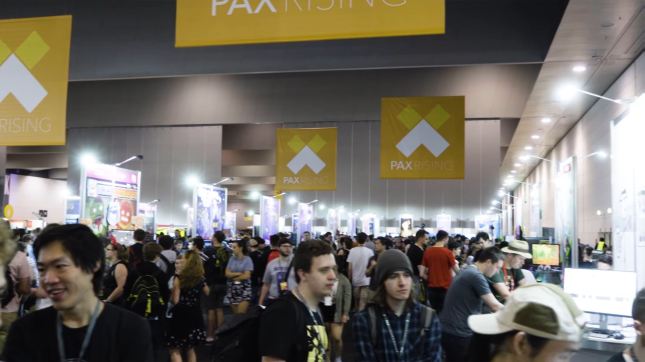
Yes, you read that correctly – we’ve thrown our hat in the ring for PAX Rising at PAX Australia (PAX AUS for short) because… well, why not? Submissions for PAX Rising were open, so I decided to fill out the form. The show is held every October in Melbourne, Victoria. Their mission statement:

“PAX Rising showcases engaging digital games developed by smaller teams. The folks at PAX believe these titles have a chance to rise above their modest beginnings, by growing as a company, establishing a fan base or pushing the industry.”

My wager here is that since a trip to Australia is so difficult, there won’t be much competition for the PAX Rising selection, meaning we have a better chance. But who can say for sure? The guidelines for PAX Rising are quite vague, so I have no idea if mobile games are even eligible. Whether or not we can go on this trip will also depend on if our game can generate the money to pay for the trip. So if you want us to go “down under” to PAX AUS, you better buy our game when it launches!

Check out a video of 2017’s PAX Rising stars on their YouTube channel here.


= = = = = = = = = = = = = = = = = = = = = = = = = = = = = = = = = = = =

We hope to see you on the road! Let us know in the comments if you will be attending any of these events. You can find out more about our game at WhereShadowsSlumber.com, ask us on Twitter (@GameRevenant), Facebookitch.io, or Twitch, and feel free to email us directly at contact@GameRevenant.com.

Frank DiCola is the founder of Game Revenant and the artist for Where Shadows Slumber.


The Triangle of Truth

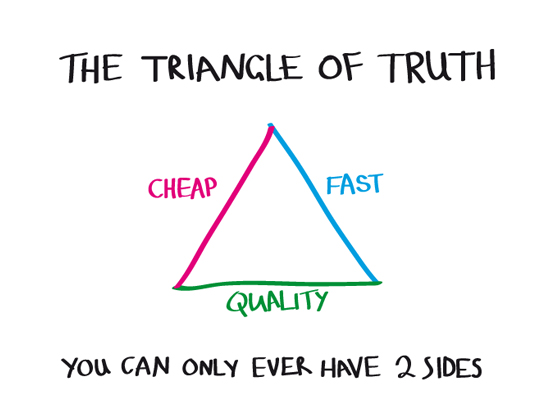
Hello again, everyone! It’s Frank again. I know you are all eagerly reading our weekly updates to find out when the game will be finished, but this week you may be disappointed. Rather than announcing a launch date, I’m going to explain to everyone the project management principles behind why Where Shadows Slumber has had such a long development cycle. We’re going to discuss the Triangle of Truth!


triangle

The Triangle, Explained

The “Triangle” refers to a project management principle that has gone by many names, visualized in the image above. This diagram has been used to describe everything from project strategies and economic models to government healthcare systems and construction projects. It’s one of those mantras that just always seems to hold true, no matter the circumstances. When you are creating something, such as a mobile video game, you’d ideally like for it to be as good as possible for the cheapest cost and have a fast development cycle. Sadly, the edicts of being demand that you must sacrifice one side of the triangle to achieve the other two. As the desired two metrics increase, the sacrificed metric must decrease. Let’s define these bolded terms first, and then talk about Where Shadows Slumber.

Good: The product stands out among the crowd as something special. We want quality to be as high as possible.

Cheap: The cost incurred creating the product. (Not to be confused with the price a consumer pays for the final product) We want our cost to be as low as possible.

Fast: Time is money, so the sooner the project is done, the better. Life is short! We want our development cycle to be as short as possible.

When you see how Where Shadows Slumber lands on this diagram, everything will start to make sense.


We Chose “Good” and “Cheap”

Jack and I are two recent college graduates who teamed up together to make video games. The development of Where Shadows Slumber is not too dissimilar from the development of SkyRunner, our previous mobile game. We decided not to spend a truckload of money on the game, so that it could be as good as we can muster at the lowest personal cost. Essentially, we decided to spend time on the game rather than cash. This is because we have no money, so it was an easy decision.

That’s not to say that I’ve spent $0 on this game! It’s fair to say tens of thousands of dollars have gone toward the development of Where Shadows Slumber, easily. But our budget is a pittance compared to large indie studios and AAA development houses. The sides of the triangle have been chosen: we want a good game, and we can’t spend a lot of money, so we’ll just have to spend as long as it takes to get the job done.

What would Where Shadows Slumber look like if we sacrificed a different portion of the triangle? Let’s analyze where we are now, and then look at the others. Right now, we’re sacrificing time.


SACRIFICE: TIME  / /  GET: QUALITY, LOW COST

Time: We’ve been working on the game since the spring of 2015, and we’ll continue to work on it over the next few months. That’s a 3 year development cycle!

Cost: Game Revenant has spent ~$25,000 to pay our audio engineers, travel to conventions, and equipment. We work from our apartments and meet in coffee houses, so we don’t spend money on rent or utilities. Jack has a full-time job and I mooch off my generous, loving and forgiving family.

Quality: The game is superb, beautiful, and time-tested. We even created a free Demo that went through extensive user testing and has stood the test of time. This informed our approach to the final game, but it took a while to get to this point.


SACRIFICE: QUALITY  / /  GET: TIME, LOW COST

Quality: We always knew we wanted Where Shadows Slumber to be an awesome, premium mobile game. But if for some reason we decided to release a poorer quality version, we’d be done by now. What would happen if we sacrificed quality by having fewer puzzles, no meaningful story, and low-quality audio produced by Frank making noises with his mouth?

Time: We already created a rudimentary throwaway version back in 2015 when we first begun work on the game. We could have cut it off right there! Also, our Demo has been available for download since November 2016, so that gives you an idea of how much time we could have saved.

Cost: Obviously you don’t need to spend a lot of money if you don’t care about the final result. Jack and I could have just created a shorter, worse game and it only would have cost us a few app store developer fees (Apple, Google Play) and the cost of buying development devices for building and testing.


SACRIFICE: MONEY  / /  GET: QUALITY, FAST DEVELOPMENT

Cost: It is possible to get investors for indie games, either by getting a loan from the bank or by appealing to groups like Indie-Fund. Jack and I briefly considered this a year ago, but by that point we had put in so much of our own time, we felt like reaping the full benefits. (Remember – investors don’t give out money for free, they want a cut of the sales!) We could conceivably have gotten $500,000 – $1,000,000 to work on this game if we put our own money in and also got some investments. If we did…

Quality: Along with our personal efforts, we could have hired a small team of veteran developers to aid me and Jack. Veteran programmers would help Jack organize his code, and veteran artists would produce work superior to mine. With Jack and I to guide their efforts, we could take a management / visionary role and let the experts do the hard work. I think the quality would be the same it is now, but it would have gotten there faster. Speaking of which…

Time: My work would be cut in half if we paid an Animator / Character Gui* to handle all of the cutscenes and humanoid animation in the game. That would free me up to work purely on environments with Jack. On the development side, we could hire a full-time Quality Assurance Gui to test the game on various devices. A full-time Marketing Gui would handle our social media efforts, press relationships, and business travel. We could have also brought Alba and Noah into the fold a lot earlier, meaning most of their work would be done by now. Every gui we hire is another hat Jack and I don’t have to wear!

*Gui is a gender-neutral version of “guy” that we used to use in Off Center


2305701220_0fc3d01183_b

There Is Always A Drawback

It should be stated that when you sacrifice a portion of the triangle, you don’t get it back. There is always a cost. If you spend money, it’s gone. If you sacrifice quality, your game suffers. And if you spend three years working on a game, you suffer.

I’ve lived in isolation for a period of three years ( ! ), all the while neglecting personal relationships with friends and families, turned down jobs, rejected business opportunities, let my body grow fat, and forgone other personal life goals in order to work on Where Shadows Slumber for as many hours a day as possible. (Imagine my surprise when I discovered that women are not eager to date a man who spends 10 hours every day in front of a computer and rarely leaves the house. Shocker!)

Jack has been working his fingers to the bone every day at not one, but TWO tasks: his full-time work at a startup in NYC and his passion project Where Shadows Slumber. He’s written about this before on our blog, and I encourage you to read his past writing. I was particularly mortified at the mention of how he has to find small scraps of time throughout the day (30 minutes in the morning, 25 on the train, 45 between arriving home from work at night and making dinner) just to work on the game. I have no right to complain – in light of his sacrifice, my life is a breeze. What kind of person would lead their friend into this kind of a life?

I don’t mean to be dramatic, but the point of this blog post is that the toll is real. Choose your sides of the triangle carefully, because the side you scorn will stop at nothing to seek revenge.


MiyamotoQuote.png

Where Shadows Slumber: Eventually Good

Miyamoto’s famous quote that “a delayed game is eventually good, but a rushed game is forever bad” may not be true anymore in a world where games can be patched and DLC can be sold. In a world where software is now a service, rushed games might eventually become good, given time.

However, this is also an industry where you live and die by your first impressions. Users don’t ever return to write a second review, and journalists move from game to game quickly. Jack and I are making a sacrifice of time to ensure that Where Shadows Slumber makes a splash when it hits the market. We can’t spend money we don’t have, but we can always put in just a bit more work.

Are you a game developer, artist, musician, writer, or creator working on a passion project? Feel free to share this blog post with your friends and family, especially if they have ever asked you “gee, when are you going to be done with this darn thing?” Let me know what they say in the comments below!


= = = = = = = = = = = = = = = = = = = = = = = = = = = = = = = = = = = =

This has been a project management blog from the creators of Where Shadows Slumber. Have a question about aesthetics that wasn’t mentioned here? You can find out more about our game at WhereShadowsSlumber.com, ask us on Twitter (@GameRevenant), Facebookitch.io, or Twitch, and feel free to email us directly at contact@GameRevenant.com.

Frank DiCola is the founder of Game Revenant and the artist for Where Shadows Slumber.