As I type this, I’m packing to go to GDC 2017 – The Game Developers Conference at the Moscone Center in San Francisco, California. The convention actually already started, believe it or not. Monday and Tuesday are incredibly expensive lectures and talks, with an expo that runs Wednesday through Friday.
Since I’ve never been to this before, I didn’t want to break the bank. Transportation to San Francisco was expensive enough, especially when you consider I’m staying in a hotel near the convention center. So I’m just going to the expo, where indie devs will be showing off their games and large companies will be holding meetings with business partners.
I have three main goals in mind for GDC 2017: scope out the convention for 2018, meet publishers and distributors, and plan the future of my company.
Case The Joint for 2018
This is a huge show, and it always happens right around this time of the year. I predict Where Shadows Slumber will be released at some point next year during this time, so it’s highly likely we’ll be attending GDC 2018 as exhibitors.
I want to ask these indie devs if they feel like it was worth the price, the trip, the time, and other costs. You never know which shows are going to give a return on your investment. This also gives me a convenient excuse to actually have fun at a trade show!
I’m so used to going to these things as an exhibitor, I forgot what it was like to be able to freely move about the show floor and talk to people. What a treat!
Also I need to make sure I get details on how to sign up for contests. GDC has a few award shows that run (two, I think?) and I know next to nothing about them. But I know that I want Where Shadows Slumber to win everything forever, so it’s time to get some information. I’ll return next week with contact people!
Meet Publishers and Distributors
It can be difficult to make a connection to someone completely online. But Jack and I need people to distribute our game in China, Japan, Korea, Russia, India, and other foreign countries. We don’t speak the language or understand the market. For a cut of the proceeds, these publishers can make our game a hit in their region.
I’m not looking to promise these people anything just yet. Mostly I want them to take a look at the game and get a conversation going. If the game is “on their radar”, then my follow up email over the summer might get noticed.
But first they need to see it. I’ll shove my iPad in their face if I have to! (I swear to God I will do this once before the show ends) I already have a hit list on my phone of who I need to hunt down at GDC, and I won’t rest until I find them!
This took a violent turn… so let’s go to the final section!
Plan For The Future
I already talked about GDC 2018, so why do I need to plan for the future? Well, you can’t work on one game forever. Even Blizzard will need to say goodbye to its beloved properties one day. Where Shadows Slumber is a beautiful game, but I have a lot more game ideas in the pipeline. Planning for what comes next is important. We may be talking as far as 2019 or 2025 here, but I plan to build this company into something great. That takes foresight.
I want to make a good first impression with some big-wigs at the largest game companies and bluntly ask them what it takes to make third-party games. There’s a lot of exciting stuff happening around VR (which I am still skeptical of), Nintendo’s Switch, and the growing PC gaming market. Now is the time to forge some professional bonds to be used at a later date. There are some technology companies in particular that I want to visit, so I can ask them some “is this possible with your tech?” questions.
I’ll try to do a recap of all this when I return, but PAX East is next week so… gah! It’s going to be a busy life, I suppose >:)
I have a taxi to the airport to catch, so see you next time! Thanks for reading.
Don’t miss updates while I’m at GDC. Share our game at WhereShadowsSlumber.com with the GDC hashtag, find us on Twitter (@GameRevenant), Facebook, itch.io, or Twitch, and feel free to email us directly with any questions or feedback at contact@GameRevenant.com.
Frank DiCola is the founder of Game Revenant and the artist for Where Shadows Slumber.
I speak now to our legions of adoring fans. *ahem*
Lend us your talents! Your eyes that see microscopic faults, your ears that hear the lies in the truth! Lend us your hands that stumble over screens and fingers that are too large! Lend us your tongue that licks the phone for some reason (??), and most importantly your mind, which is not satisfied until there are 999 levels in the game!
“Ask not what Game Revenant can do for you, but rather what you can do for Game Revenant!”
[The crowd goes wild]
The call has gone out to Android Revenants and Apple Revenants alike. Your Supreme Chancellor has need of you!
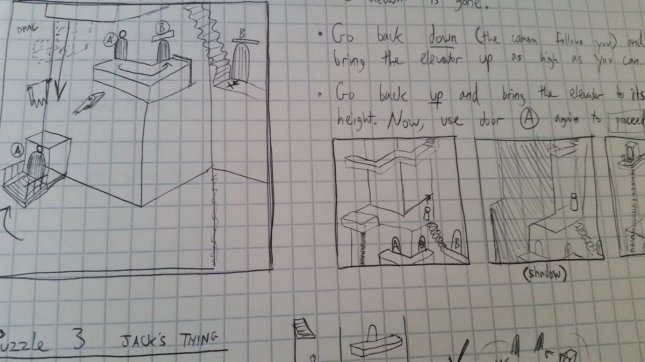
Part of a paper concept for the upcoming level “Ramparts”.
Jack and I have been hard at work the past two months designing every level in the game on paper. Now we need Volunteer Revenants who are willing to take 15 minutes out of their day to test these new levels. We’ll be sending you an early, near-prehistoric version of the final game. Levels will be blocky, ugly, and impossibly grey. They will have either no sound, or limited sound. You probably won’t enjoy playing them.
Sold yet? Listen, we need your perspective. We think these levels are perfect. Do you know why we think that? Because we designed them! Of course we think they are perfect. They are not. We need you to download the test version of the game and then tell us via Facebook, Twitter, or private email (contact@GameRevenant.com) what you think. Be honest!
I played the demo available on the App Store. Does that count?
Thanks so much, but no. We’re moving past that now — we’re talking about new levels for the final game. Not many demo levels will make it to the real game.
How do I become an iOS tester?
You’ll need the app “TestFlight” on your modern iOS device (iPad, iPhone, iPod Touch) and you’ll need to send us your email address to opt into the program. We’ll add you to the list and send out levels in waves, probably one World each month.
How do I become an Android tester?
You must send us your email address so we can figure something out. TestFlight does not work with Android so we need a different solution. We may just email you an .apk file with some levels in it.
What’s the deal with Kindle Fire?
I don’t really know… we aren’t on that store yet, it’s a long process. Hang tight!
I have a Windows Phone…
Windows Phone is kind of a small market and we don’t have one of those devices to use for testing. We will probably not publish on the Windows platform for a while, if at all.
You guys get free quality assurance from this. What do I get out of it?
You get the satisfaction of knowing you’re helping us make a great game! You get to see the game early, before anyone else. You get to tell us what you think and make a real impact on the game. Plus, if you pester us enough and your feedback is helpful (instead of just annoying) we can probably put you in the Credits as one of our “Worldwide Quality Assurance Experts”. Play games in your pajamas and get into the Credits… what’s better than that?
OK
OK?
Yes
Great! Send your information to contact@GameRevenant.com. All we need is your email, device operating system, and device version/name. You’ll be sorted and placed in the appropriate email list. Expect a brief from us soon about how you can be a Test Revenant!
Although I don’t recommend it, you can also give us your email through the Game Revenant official Facebook Page or Twitter Handle. I also have a Twitch game development stream, so I guess you could hop into the chat and message me? Don’t do that, though. Spammers are always looking for information in the chat! Email the official address at contact@GameRevenant.com.
Frank DiCola is the founder of Game Revenant and the artist for Where Shadows Slumber.
One of the most difficult parts of game development is staying motivated. I can’t tell you how many projects I’ve started, a great idea and achievable goal in mind, only to have those projects fall by the wayside, almost but not quite finished. Last time I talked about dealing with adversity; this week, I’m going to talk about how to stay motivated when working on a game development project.
As game developers, we love games, and we love developing games. When you first come up with a great concept for a game, you’re excited about it. You have so many great ideas, and you just can’t wait to implement them. You have an image of what your game will look like in 2 years, and with that pristine goal in mind, you simply feel driven to work on it.
As you work on your game, however, that drive begins to falter. Where you once looked forward to sitting down for an hour or two of coding, you find yourself shying away from your computer. You look at your game and all the effort you’ve put into it, and you realize how far away you are from the perfect game you had imagined. Rather than tackling cool, big-picture things like core mechanics, you find yourself slogging through your levels, double-checking initialization values.
Basically, there comes a time in the development of a game where the fun parts are over. Your motivation is at its lowest, the work is the least interesting it’s been so far, and your noticeable progress has slowed to a crawl. You find yourself with a solid, but definitely half-finished game, and it feels like it will never be any more than that.
Depressing, huh? Let’s find out how to avoid letting your game succumb to this fate!
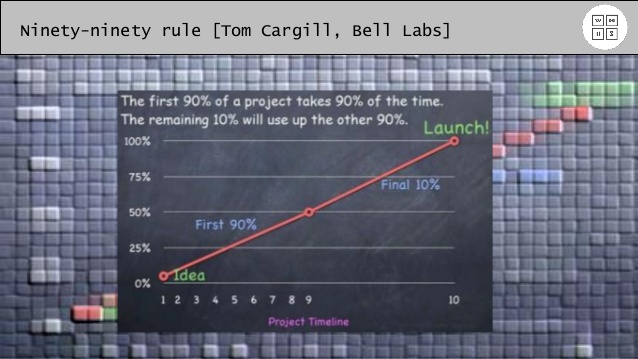
“The first 90 percent of the code accounts for the first 90 percent of the development time. The remaining 10 percent of the code accounts for the other 90 percent of the development time.” – Tom Cargill, Bell Labs
The Ninety-Ninety Rule
The ninety-ninety rule is a saying that describes a lot of the difficulties associated with software development. It works on two levels, both of which are relevant here.
First, the shrewd reader will notice that the total development time in the quote adds up to 180%. This, of course, cannot be true in a literal sense; rather, this is a reference to the fact that estimates of development time for a project are almost always woefully low. If this is to be believed, then these projects take almost twice as long as estimated! In my experience, this is very accurate.
Secondly, we can look at the values used above. We see that the last ten percent of the code accounts for just as much time as the first ninety percent! While this seems nonsensical, it is perfectly true. Anyone who has made it 90% of the way through a software project can attest that the last 10% always drags on and on. When developing Where Shadows Slumber, for instance, I found myself with a game in which every core game mechanic was completely developed within 10 months of starting! And yet here we are, nearly two years into development, and the game is still not complete (and not just because I’ve been slacking off this whole time).
The ninety-ninety rules helps explain why we start to feel so depressed as we reach what appears to be the 90% mark of our game. We feel like our game is almost done, and it’s taken just as much time as expected – awesome, we should be done in a few more weeks! What we don’t realize is that we’re really only halfway done. Since we don’t realize that fact, we don’t understand why our expected release date has came and gone. We missed our deadline, our project is dragging on, we aren’t really enjoying the work anymore, and we still don’t understand why the last 10% of the work is taking forever. With all of these things weighing down on us, it’s understandable when we start to lose faith in our game.
So, now that we understand some of the reasons behind this phenomenon, lets look at some ways to deal with it.
Set Realistic Expectations
A big part of the problem is feeling like you’re falling short of what you should be doing. The problem, however, isn’t with your work – it’s with your expectations. While you may be falling behind the schedule you set for yourself, you’re actually right on track – with the actual schedule for the game.
I’ve worked on a lot of software projects, and I would estimate that only around one in a hundred are actually completed by the original deadline. These types of projects are simply hard to estimate, and often take much longer than you would think. That’s why, whenever I have to estimate the time for a task, I always take my best, most realistic guess. And then I double it. Even after all this time, my best guess falls far short of reality, and the doubled timeline is far more accurate.
In addition to schedule expectations, this tip also applies to your game itself. If you start your one-man project, aiming to create the best MMORPG the world has ever seen, of course you’re going to fall short! You have to decide what you can reasonably accomplish, and at what level of quality, and then aim for that. If your game is starting to look like your goal, you’ll be much more motivated than if your goal is a perfect game that you’ll never be able to make.
I’ve spent a lot of time doing a lot of fun activities – game jams, NaNoWriMo, Ludum Dares, etc. But, since we started the development of Where Shadows Slumber, I have refrained from participating in any of them. It’s not that I no longer enjoy these things, it’s simply that I want to avoid distractions.
As you work on your game, you feel less and less excited about it – it’s only natural. This loss of excitement can be very dangerous to your game. Other projects are still out there, and they probably still seem very exciting to you. But it’s a slippery slope; it’s all too easy to take a few days off for a game jam, then you take a week off for something else, and before you know it, you’ve put your game on hold so that you can spend a few months working on a prototype for a new game. Betrayal!
I find the best way to avoid letting other things take over is to avoid those other things altogether. Perhaps some of you with stronger willpower or more time might be able to risk it a bit more, but be careful – it really is a slippery slope.
On the other hand, you don’t want to take this too far. Getting burnt out is very easy to do, especially when you’re spending a lot of time on a game. Sometimes I’ll sit down at my computer with the intention to work on Where Shadows Slumber, stare dejectedly at the screen for a few seconds, and then boot up StarCraft instead. If other game jams are your StarCraft, then go for it. As long as you’re continuing to work on your real game, and you don’t spend too much time on other things, it’s healthy to give yourself the night (or the weekend) off every once in a while.
Scheduling
This tip is something that I simply stumbled upon, but it has proven very helpful in forcing myself to work on Where Shadows Slumber. A year or so ago, I got a new job. My body still wakes me up by 8 am, but I don’t have to leave for work until 9:30 am! Woe is me!
This was actually an awesome development. Previously, I would work on my game whenever I could find the time – an hour here, twenty minutes there, etc. Now, I have an hour and a half every morning with nothing else to do. That time has become game-time;now I work on Where Shadows Slumber every morning for an hour or so.
One of the hardest parts of game development when you have a ‘day job’ is getting consistent time to work on it. I’m pretty fortunate in that the time I need was basically forced on me, but the principle holds. Find a schedule that works for you, and set that time aside as game-time. Don’t let anything else cut into that scheduled time – after all, it’s already booked! Whether it’s thirty minutes every Saturday morning, or two hours every night, blocking off a chunk of time for game development work will help you make consistent progress on your game.
Buckle Down
My last tip is less of an actionable item, and more of a mindset. There will be times when you sit down to work on your game, and you find that you simply do not want to. This happens, is perfectly normal, and is nothing to be worried about. As I mentioned earlier, when this happens to you, it’s absolutely fine for you to just take the night off and do something relaxing.
However… If you take a night off every once in a while, it’s fine. If you find yourself taking off multiple nights every week, you might be in a bit more trouble. Sometimes you don’t want to work on your game, but you have to anyways. You have to sit down, open up your game, and force yourself to work on it. If you never push your game forward, you’ll never get it into a spot where you want to work on it, and it will stagnate. This is an opportunity for your game to die, and you don’t want that to happen.
There you have it! These are my four biggest tips for staying motivated and continuing your game’s development. There’s obviously a lot more to keep in mind, and a lot of stuff I mentioned that’s hard to do, but I hope you’re able to put some of this to good use, and I wish you all successful, completed games!
As always, let us know if you have any questions or feedback! You can find out more about our game at WhereShadowsSlumber.com, find us on Twitter (@GameRevenant), Facebook, itch.io, or Twitch, and feel free to email us directly with any questions or feedback at contact@GameRevenant.com.
Jack Kelly is the head developer and designer for Where Shadows Slumber.
FRIEND. Hey Jack, what’s up? You’re usually up to something interesting – are you working on anything right now?
JACK. Hey man – yeah, we just started working on a mobile puzzle game based on shadows! Basically-
FRIEND. Mobile? People are still doing that? I thought that mobile gaming was over [and anyone who decides to make a mobile game is a complete idiot!]”
I don’t think I quoted the above conversation exactly right, but I will say that it is exactly what you do hear as a game developer when these types of conversations occur. Deciding to go into indie game development can be a big risk, and while these conversations are important, they really aren’t that much fun.
In this post I’m going to delve into the concept of adversity and how to deal with it. This will be the first in a three-part series of blogs, all about staying focused and productive.
Dealing With Criticism
Criticism is one of the most important aspects of game development, especially for indies. You need to know what people don’t like about your game, so that you can fix it. As such, people tend to be very forthcoming with their criticisms.
However, after endless hours of hard work, it’s easy for a developer to have trouble dealing with criticism. And it’s easy for a friend, intending to offer constructive criticism, to end up simply insulting or demotivating a developer.
Throughout the development of a game, us developers put a lot of thought and work into creating something we can be proud of. When someone else picks apart our creation, we often wonder – why does everyone make sure that us developers find out everything they dislike about our game?
Game development is a field that lives and dies by the opinions of players. The best way to find out what you need to change about your game is to ask your audience. And the best way for a gamer to ensure that a game ends up being good is to tell the developers what they don’t like. This relationship is a very good one, so don’t take it for granted.
Types of Adversity
How can game developers prepare to deal with adversity? By knowing what to expect.
Handling Detractors
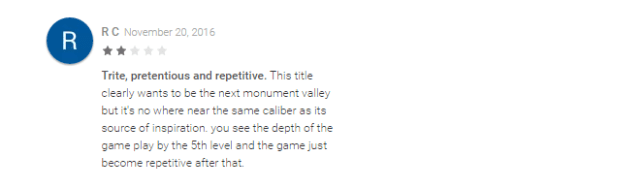
This was an early review of the Where Shadows Slumber demo for Android.
This is the most obvious type of adversity, and the type we have come to expect. No matter how awesome your game is, there will always be people who simply do not like it, and you will always hear from them. Something about your game is not good enough for them, whether it’s too short, or the graphics aren’t good enough, or the gameplay is too simple.
“You game is a big ol’ stupid!”
– Some dude who hates your game
The best way to deal with this type of adversity is to learn what you can from it, and then to let it go. Unfortunately, it’s impossible to please everyone. You game may be made for many different people to enjoy, but you still have a target audience, and a lot of people will fall outside of that audience. If you focus too much on trying to please every person who says something bad about your game, you’ll just drive yourself crazy. Just accept that this person will probably never love your game, and continue trying to make it the best it can be for those people who will enjoy playing it.
Handling Constructive Criticism
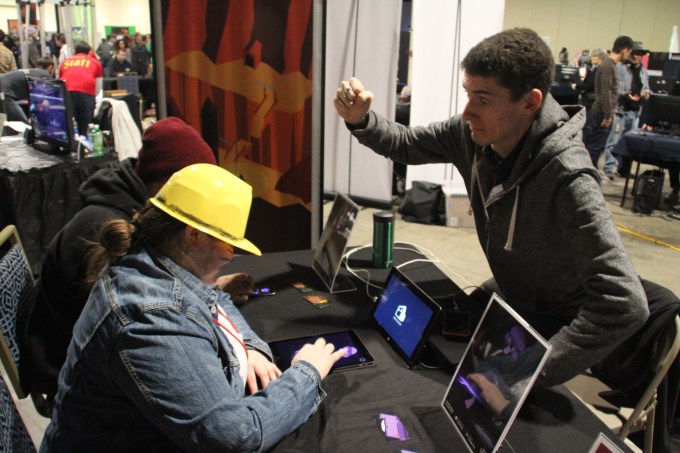
(Above) The incorrect way to respond to constructive criticism.
Constructive criticism is the lifeblood of the indie gaming community, and any developer who really wants to do well is always on the lookout for it. Constructive criticism tells you what parts of your game need improvement, and it comes directly from the mouth of your target audience.
This is a very important point – I can’t tell you how many times we implemented a feature that we thought would be cool, only to find that our fans didn’t like it. Sometimes you make the wrong decision (especially when working in a small team), and constructive criticism helps you find out what things you need to change before it’s too late.
“Tell us what you hate about our game. We have thick skin, we can take it!”
– Frank, at every convention we go to
This is the easiest type of adversity to deal with, since we are constantly seeking it. This person likes your game, and they’re just trying to make it better, so they can enjoy it even more! The most important thing about constructive criticism is to always be ready for it, and to always listen to and learn from it. The player told you exactly what they want – try to give it to them!
Handling Friends Who Are Trying To Help
“You can do this, but to be more accurate, you probably can’t.” – Barney Stinson
The third type of adversity I’ll talk about today is one that I wouldn’t really have expected, when I first went into game development, and is the main reason that I decided to write about this topic. That is the adversity that you receive from your friends.
“But wait, didn’t we just talk about that? Your friends are giving you constructive criticism, right?”
Yes, your friends are often a good source of constructive criticism. Maybe my friends are just the worst, but I’ve also noticed another, more sinister type of criticism.
“I’m only saying this because I care about you – you are literally the worst.”
– Your ‘friends’
Your friends love you, and having them in your life is awesome. However, they don’t always share your passions, specifically about game development. Many of them might think that you’re getting your hopes up and stressing yourself out for no reason. Maybe you don’t spend as much time with them as you used to. Maybe they’re just jealous of how awesome your game is. Whatever the reason, they’ll probably let you know.
I’ve heard a lot of different comments, but most of them begin with some form of “I’m saying this because I care about you…” This is the ultimate way a friend will disguise a negative comment. A lot of times you’ll hear something like “You know your game isn’t going to take off, right? I just don’t want you to get your hopes up,” or “Why are you wasting so much time on that – I mean, it’s just a hobby, right?”
Perhaps they are saying it because they care about you, and perhaps they mean well. Game development requires a lot of motivation and momentum, and hearing these things from the people who most care about you can be very disheartening. Sometimes you need to hear these things, but if you’re simply committed to creating something you can be proud of, you don’t need that kind of demotivation.
So how do we best deal with this type of adversity? To be honest, I wish I knew. The easier strategy is to simply nod along with them – “yeah, I know my game isn’t that great, but it’s a fun hobby.” This doesn’t seem fair to you, as you’ve put a lot of work into your game, but it’ll get them off your back. The other strategy is to explain to them that you’re doing everything you can to make this game a success. You’re putting a lot of work into it, and you would appreciate their support. If they have any constructive feedback, you would love to hear it.
Honestly, I think the second strategy is probably better, but as an introverted developer, I find myself utilizing the first more often. This is something I’m working on, but I think this is the type of adversity that is the most difficult to overcome. If you have any tips or thoughts about this one, we would love to hear from you!
Hopefully this post gives you a little bit of insight into some of the types of adversity you will most likely see as a game developer, and how to deal with them. Next time I’m going to discuss another topic that I find plagues me and many other game developers: staying motivated.
Until then, let us know if you have any questions or feedback! As always, you can find out more about the game at WhereShadowsSlumber.com, find us on Twitter (@GameRevenant), Facebook, itch.io, or Twitch, and feel free to email us directly with any questions or feedback at contact@GameRevenant.com.
Jack Kelly is the head developer and designer for Where Shadows Slumber.











 Game Revenant