3 Things I Learned at GDC 2017

I’ve just returned from a whirlwind trip to this year’s Game Developers Conference (GDC), and I have a lot to tell you! Unfortunately, most of what I learned is top secret. You hear a lot at these conventions, so between secret news and talks with undisclosed mobile publishers there isn’t a lot I can disclose. More on that later this year…

But I can certainly reveal my impressions as a first-timer to help you out if you’re planning on going to GDC 2018. Here are three things I learned my first time at GDC!


Calendar with pushpins

Lesson 1: Schedule Meetings Months Ahead of Time

My number one priority at GDC 2017 was to talk to someone from the App Store about Where Shadows Slumber. My number two priority was to talk to someone from Google Play. Specifically, I’m looking for the people that make promotions and “features” happen. Being featured on an app marketplace can sometimes be the difference between relative obscurity and worldwide fame. It’s that important.

Certainly it can’t be your only strategy, but it’s at the top of my list. Sadly, I failed! Since I was so late to the game (I only found out about GDC when two people mentioned it at MAGFest 2017 earlier this year) I never scheduled times to meet with them. Naively, I assumed there would be some kind of Apple booth and I could meet them there.

No way. Although the major players (PlayStation, Oculus, Facebook, Microsoft, Unity) had large presences at the show, Apple did not have a booth. They probably assume they would just get inundated by indies and it wouldn’t be worth the expense. If you wanted to talk to them, you had to get on their calendar months in advance. They met with business partners in secret rooms during the show, protected under heavy guard. The same is true for Google – they had a booth, but it was specifically to show off Daydream, their mobile VR peripheral. The Google Play team was nowhere to be found.

I learned the hard way – don’t make my mistake! It’s crucial that you do your homework ahead of time and get on the calendar of a major player like Apple, Google, Nintendo, or whoever you want to meet. Don’t leave this stuff to chance!


20170303_101342

GDC talk about Chinese localization pitfalls, given by Jung-Sheng Lin of Taiwan.


Lesson 2: The Talks Are Great, But You’ll Get Tossed Out

I went to GDC primarily to make connections in the industry. I wasn’t expecting to enjoy the seminars as much as I did. It turns out there are a lot of talks, panels and seminars at GDC and they run the full week. (I arrived on Wednesday, since I was mostly concerned with the Expo – but there are talks and parties beginning on Sunday) The lectures were great! I enjoyed pretty much every one that I went to. The panels weren’t as interesting as the talks because less work went into preparing them. But overall, I was impressed.

One thing bugged me though. I should have seen this coming, but when you buy a pass for GDC you’re effectively selecting what access you’ll have during the show. They have all kinds of “tracks” – Art, Music, VR, All Access, Mega Golden God Status, etc. I got an Expo Pass, which is the cheapest option. This lets you into the Expo and a small smattering of talks.

What this meant was that often I would see a talk advertised (“Nintendo Reveals All About Breath of the Wild!”) and get really excited for it only to be turned away at the door. The paper pocket guide doesn’t warn you about the access required for a talk, it just says where the talk is and who is giving it. To see a filtered view, you need the app. Once I filtered the talks available by the Expo Pass using the GDC app, it become clear that there really wasn’t too much I was interested in. Fortunately I snuck into at least one restricted talk (it was about early access and Ark) and the talks I was able to get into were pretty good. Still, it’s a bad feeling.

So, again, plan ahead! Before you buy a badge, look at the talks available. Filter the list. Ask yourself – are the seminars worth the price jump from $299 to $999? If so, take the plunge. You’ll appreciate getting the access. Otherwise, just deal with the consequences and don’t be surprised when ushers show you the door.


20170307_134433

Lesson 3: Don’t Take No For An Answer

The theme of the first two Lessons is quite clear: plan ahead. Having said that, I should also mention that just because you didn’t plan ahead doesn’t mean you shouldn’t muscle your way in anyway.

Rules only matter if they’re enforced, right? Once they stop being enforced they might as well not even apply. Although I don’t believe this is true when it comes to objective morality (don’t go burning down houses because you think you’ll get away with it), it certainly works when it comes to event admissions.

For example, I went to the Big Indie Pitch at GDC 2017 after some urging by Craig Barnes (I owe you one, man!). This is a pitching contest where you show your mobile game to publishers and industry professionals. You get 4 minutes with 5 different groups each, and they judge your game based on its aesthetics, mechanics, marketability, and overall quality. But I never formally applied for the contest because I missed the submission cut-off by one day. Feeling dejected, I almost didn’t even attend! It was 3 pm on a Thursday, I was already exhausted, the event wasn’t close to the convention center, and I very nearly bailed to go to other events instead.

Something told me I’d regret it if I didn’t at least show up, so I took an Uber over. As the event began, I begged the event coordinator Simon Drake of Steel Media to put me on a Waitlist. If people didn’t show up, I could take their slot! There were four others like me so Simon agreed, and to our surprise the Waitlisters were given a chance at the tail end of the contest to make our case to the judges. (OK, this isn’t really “muscling”, more like “pleading”… but you get the point!)

To my utter shock, Where Shadows Slumber received third place at the Big Indie Pitch! Jack and I now have $1,000 in marketing money to use on any of Steel Media’s owned platforms, and we’ll put it to good use. Another awesome thing: the second place winner, Louard of Suzy Cube, was also on the Waitlist! The moral of the story? Plan ahead, and plan for everything.

Then, expect your plans to go wrong, and don’t give up when they do!


I’m going back to GDC next year for sure. We may exhibit at the show, or just walk the show floor. I definitely want Jack to see this, because it’s an awesome experience. Where Shadows Slumber will hopefully be commercially available by GDC 2018 so the timing should be perfect… but you know what they say about plans.


= = = = = = = = = = = = = = = = = = = = = = = = = = = = = = = = = = = =

Were you at GDC 2017? Tell us about your experience in the comments below! You can find out more about our game at WhereShadowsSlumber.com, find us on Twitter (@GameRevenant), Facebook, itch.io, or Twitch, and feel free to email us directly with any questions or feedback at contact@GameRevenant.com.

Frank DiCola is the founder of Game Revenant and the artist for Where Shadows Slumber.

Heading to GDC 2017 Today!

As I type this, I’m packing to go to GDC 2017 – The Game Developers Conference at the Moscone Center in San Francisco, California. The convention actually already started, believe it or not. Monday and Tuesday are incredibly expensive lectures and talks, with an expo that runs Wednesday through Friday.

Since I’ve never been to this before, I didn’t want to break the bank. Transportation to San Francisco was expensive enough, especially when you consider I’m staying in a hotel near the convention center. So I’m just going to the expo, where indie devs will be showing off their games and large companies will be holding meetings with business partners.

I have three main goals in mind for GDC 2017: scope out the convention for 2018, meet publishers and distributors, and plan the future of my company.


gdc

Case The Joint for 2018

This is a huge show, and it always happens right around this time of the year. I predict Where Shadows Slumber will be released at some point next year during this time, so it’s highly likely we’ll be attending GDC 2018 as exhibitors.

I want to ask these indie devs if they feel like it was worth the price, the trip, the time, and other costs. You never know which shows are going to give a return on your investment. This also gives me a convenient excuse to actually have fun at a trade show!

I’m so used to going to these things as an exhibitor, I forgot what it was like to be able to freely move about the show floor and talk to people. What a treat!

Also I need to make sure I get details on how to sign up for contests. GDC has a few award shows that run (two, I think?) and I know next to nothing about them. But I know that I want Where Shadows Slumber to win everything forever, so it’s time to get some information. I’ll return next week with contact people!


idreamsky


Meet Publishers and Distributors


It can be difficult to make a connection to someone completely online. But Jack and I need people to distribute our game in China, Japan, Korea, Russia, India, and other foreign countries. We don’t speak the language or understand the market. For a cut of the proceeds, these publishers can make our game a hit in their region.

I’m not looking to promise these people anything just yet. Mostly I want them to take a look at the game and get a conversation going. If the game is “on their radar”, then my follow up email over the summer might get noticed.

But first they need to see it. I’ll shove my iPad in their face if I have to! (I swear to God I will do this once before the show ends) I already have a hit list on my phone of who I need to hunt down at GDC, and I won’t rest until I find them!

This took a violent turn… so let’s go to the final section!


maxresdefault

Plan For The Future

I already talked about GDC 2018, so why do I need to plan for the future? Well, you can’t work on one game forever. Even Blizzard will need to say goodbye to its beloved properties one day. Where Shadows Slumber is a beautiful game, but I have a lot more game ideas in the pipeline. Planning for what comes next is important. We may be talking as far as 2019 or 2025 here, but I plan to build this company into something great. That takes foresight.

I want to make a good first impression with some big-wigs at the largest game companies and bluntly ask them what it takes to make third-party games. There’s a lot of exciting stuff happening around VR (which I am still skeptical of), Nintendo’s Switch, and the growing PC gaming market. Now is the time to forge some professional bonds to be used at a later date. There are some technology companies in particular that I want to visit, so I can ask them some “is this possible with your tech?” questions.

I’ll try to do a recap of all this when I return, but PAX East is next week so… gah! It’s going to be a busy life, I suppose >:)


I have a taxi to the airport to catch, so see you next time! Thanks for reading.


= = = = = = = = = = = = = = = = = = = = = = = = = = = = = = = = = = = =

Don’t miss updates while I’m at GDC. Share our game at WhereShadowsSlumber.com with the GDC hashtag, find us on Twitter (@GameRevenant), Facebook, itch.io, or Twitch, and feel free to email us directly with any questions or feedback at contact@GameRevenant.com.

Frank DiCola is the founder of Game Revenant and the artist for Where Shadows Slumber.

Calling All Testers!

I speak now to our legions of adoring fans. *ahem*

Lend us your talents! Your eyes that see microscopic faults, your ears that hear the lies in the truth! Lend us your hands that stumble over screens and fingers that are too large! Lend us your tongue that licks the phone for some reason (??), and most importantly your mind, which is not satisfied until there are 999 levels in the game!

john_f_kennedy-h

“Ask not what Game Revenant can do for you, but rather what you can do for Game Revenant!”

[The crowd goes wild]

The call has gone out to Android Revenants and Apple Revenants alike. Your Supreme Chancellor has need of you!

c4pi-04vyaausr_

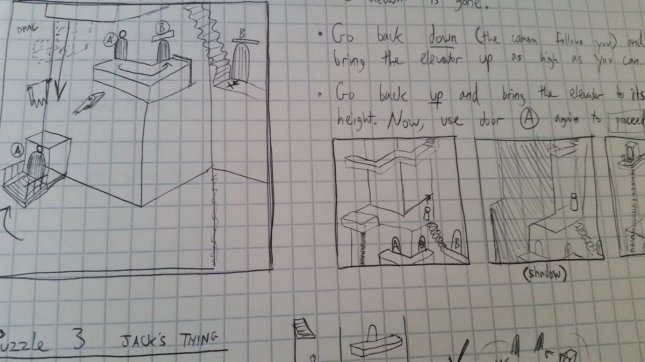
Part of a paper concept for the upcoming level “Ramparts”.

Jack and I have been hard at work the past two months designing every level in the game on paper. Now we need Volunteer Revenants who are willing to take 15 minutes out of their day to test these new levels. We’ll be sending you an early, near-prehistoric version of the final game. Levels will be blocky, ugly, and impossibly grey. They will have either no sound, or limited sound. You probably won’t enjoy playing them.

Sold yet? Listen, we need your perspective. We think these levels are perfect. Do you know why we think that? Because we designed them! Of course we think they are perfect. They are not. We need you to download the test version of the game and then tell us via Facebook, Twitter, or private email (contact@GameRevenant.com) what you think. Be honest!

greygrongus

I played the demo available on the App Store. Does that count?

Thanks so much, but no. We’re moving past that now — we’re talking about new levels for the final game. Not many demo levels will make it to the real game.

How do I become an iOS tester?

You’ll need the app “TestFlight” on your modern iOS device (iPad, iPhone, iPod Touch) and you’ll need to send us your email address to opt into the program. We’ll add you to the list and send out levels in waves, probably one World each month.

How do I become an Android tester?

You must send us your email address so we can figure something out. TestFlight does not work with Android so we need a different solution. We may just email you an .apk file with some levels in it.

What’s the deal with Kindle Fire?

I don’t really know… we aren’t on that store yet, it’s a long process. Hang tight!

I have a Windows Phone…

Windows Phone is kind of a small market and we don’t have one of those devices to use for testing. We will probably not publish on the Windows platform for a while, if at all.

You guys get free quality assurance from this. What do I get out of it?

You get the satisfaction of knowing you’re helping us make a great game! You get to see the game early, before anyone else. You get to tell us what you think and make a real impact on the game. Plus, if you pester us enough and your feedback is helpful (instead of just annoying) we can probably put you in the Credits as one of our “Worldwide Quality Assurance Experts”. Play games in your pajamas and get into the Credits… what’s better than that?

tanuki2b-2bi2bwill2bdo2bit2bi2bwill2btake2bthe2bring2binto2bmordor

OK

OK?

Yes

Great! Send your information to contact@GameRevenant.com. All we need is your email, device operating system, and device version/name. You’ll be sorted and placed in the appropriate email list. Expect a brief from us soon about how you can be a Test Revenant!


= = = = = = = = = = = = = = = = = = = = = = = = = = = = = = = = = = = =

Although I don’t recommend it, you can also give us your email through the Game Revenant official Facebook Page or Twitter Handle. I also have a Twitch game development stream, so I guess you could hop into the chat and message me? Don’t do that, though. Spammers are always looking for information in the chat! Email the official address at contact@GameRevenant.com.

Frank DiCola is the founder of Game Revenant and the artist for Where Shadows Slumber.

Where Shadows Slumber: Staying Motivated

One of the most difficult parts of game development is staying motivated. I can’t tell you how many projects I’ve started, a great idea and achievable goal in mind, only to have those projects fall by the wayside, almost but not quite finished. Last time I talked about dealing with adversity; this week, I’m going to talk about how to stay motivated when working on a game development project.

As game developers, we love games, and we love developing games. When you first come up with a great concept for a game, you’re excited about it. You have so many great ideas, and you just can’t wait to implement them. You have an image of what your game will look like in 2 years, and with that pristine goal in mind, you simply feel driven to work on it.

As you work on your game, however, that drive begins to falter. Where you once looked forward to sitting down for an hour or two of coding, you find yourself shying away from your computer. You look at your game and all the effort you’ve put into it, and you realize how far away you are from the perfect game you had imagined. Rather than tackling cool, big-picture things like core mechanics, you find yourself slogging through your levels, double-checking initialization values.

Basically, there comes a time in the development of a game where the fun parts are over. Your motivation is at its lowest, the work is the least interesting it’s been so far, and your noticeable progress has slowed to a crawl. You find yourself with a solid, but definitely half-finished game, and it feels like it will never be any more than that.

Depressing, huh? Let’s find out how to avoid letting your game succumb to this fate!


webcamp-2016-pm-bpa-rd-17-638

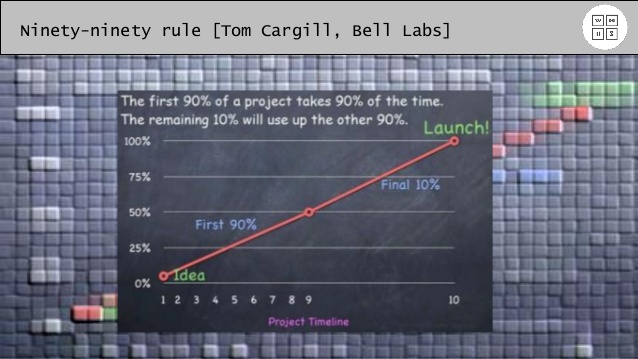
“The first 90 percent of the code accounts for the first 90 percent of the development time. The remaining 10 percent of the code accounts for the other 90 percent of the development time.” – Tom Cargill, Bell Labs

The Ninety-Ninety Rule


The ninety-ninety rule is a saying that describes a lot of the difficulties associated with software development. It works on two levels, both of which are relevant here.

First, the shrewd reader will notice that the total development time in the quote adds up to 180%. This, of course, cannot be true in a literal sense; rather, this is a reference to the fact that estimates of development time for a project are almost always woefully low. If this is to be believed, then these projects take almost twice as long as estimated! In my experience, this is very accurate.

Secondly, we can look at the values used above. We see that the last ten percent of the code accounts for just as much time as the first ninety percent! While this seems nonsensical, it is perfectly true. Anyone who has made it 90% of the way through a software project can attest that the last 10% always drags on and on. When developing Where Shadows Slumber, for instance, I found myself with a game in which every core game mechanic was completely developed within 10 months of starting! And yet here we are, nearly two years into development, and the game is still not complete (and not just because I’ve been slacking off this whole time).

The ninety-ninety rules helps explain why we start to feel so depressed as we reach what appears to be the 90% mark of our game. We feel like our game is almost done, and it’s taken just as much time as expected – awesome, we should be done in a few more weeks! What we don’t realize is that we’re really only halfway done. Since we don’t realize that fact, we don’t understand why our expected release date has came and gone. We missed our deadline, our project is dragging on, we aren’t really enjoying the work anymore, and we still don’t understand why the last 10% of the work is taking forever. With all of these things weighing down on us, it’s understandable when we start to lose faith in our game.

So, now that we understand some of the reasons behind this phenomenon, lets look at some ways to deal with it.


climbing_2651239b


Set Realistic Expectations

A big part of the problem is feeling like you’re falling short of what you should be doing. The problem, however, isn’t with your work – it’s with your expectations. While you may be falling behind the schedule you set for yourself, you’re actually right on track – with the actual schedule for the game.

I’ve worked on a lot of software projects, and I would estimate that only around one in a hundred are actually completed by the original deadline. These types of projects are simply hard to estimate, and often take much longer than you would think. That’s why, whenever I have to estimate the time for a task, I always take my best, most realistic guess. And then I double it. Even after all this time, my best guess falls far short of reality, and the doubled timeline is far more accurate.

In addition to schedule expectations, this tip also applies to your game itself. If you start your one-man project, aiming to create the best MMORPG the world has ever seen, of course you’re going to fall short! You have to decide what you can reasonably accomplish, and at what level of quality, and then aim for that. If your game is starting to look like your goal, you’ll be much more motivated than if your goal is a perfect game that you’ll never be able to make.


Avoid Distractions

let_go

Credit: xkcd.com

I’ve spent a lot of time doing a lot of fun activities – game jams, NaNoWriMo, Ludum Dares, etc. But, since we started the development of Where Shadows Slumber, I have refrained from participating in any of them. It’s not that I no longer enjoy these things, it’s simply that I want to avoid distractions.

As you work on your game, you feel less and less excited about it – it’s only natural. This loss of excitement can be very dangerous to your game. Other projects are still out there, and they probably still seem very exciting to you. But it’s a slippery slope; it’s all too easy to take a few days off for a game jam, then you take a week off for something else, and before you know it, you’ve put your game on hold so that you can spend a few months working on a prototype for a new game. Betrayal!

I find the best way to avoid letting other things take over is to avoid those other things altogether. Perhaps some of you with stronger willpower or more time might be able to risk it a bit more, but be careful – it really is a slippery slope.

On the other hand, you don’t want to take this too far. Getting burnt out is very easy to do, especially when you’re spending a lot of time on a game. Sometimes I’ll sit down at my computer with the intention to work on Where Shadows Slumber, stare dejectedly at the screen for a few seconds, and then boot up StarCraft instead. If other game jams are your StarCraft, then go for it. As long as you’re continuing to work on your real game, and you don’t spend too much time on other things, it’s healthy to give yourself the night (or the weekend) off every once in a while.


Calendar with pushpins


Scheduling

This tip is something that I simply stumbled upon, but it has proven very helpful in forcing myself to work on Where Shadows Slumber. A year or so ago, I got a new job. My body still wakes me up by 8 am, but I don’t have to leave for work until 9:30 am! Woe is me!

This was actually an awesome development. Previously, I would work on my game whenever I could find the time – an hour here, twenty minutes there, etc. Now, I have an hour and a half every morning with nothing else to do. That time has become game-time; now I work on Where Shadows Slumber every morning for an hour or so.

One of the hardest parts of game development when you have a ‘day job’ is getting consistent time to work on it. I’m pretty fortunate in that the time I need was basically forced on me, but the principle holds. Find a schedule that works for you, and set that time aside as game-time. Don’t let anything else cut into that scheduled time – after all, it’s already booked! Whether it’s thirty minutes every Saturday morning, or two hours every night, blocking off a chunk of time for game development work will help you make consistent progress on your game.


Buckle Down

My last tip is less of an actionable item, and more of a mindset. There will be times when you sit down to work on your game, and you find that you simply do not want to. This happens, is perfectly normal, and is nothing to be worried about. As I mentioned earlier, when this happens to you, it’s absolutely fine for you to just take the night off and do something relaxing.

However… If you take a night off every once in a while, it’s fine. If you find yourself taking off multiple nights every week, you might be in a bit more trouble. Sometimes you don’t want to work on your game, but you have to anyways. You have to sit down, open up your game, and force yourself to work on it. If you never push your game forward, you’ll never get it into a spot where you want to work on it, and it will stagnate. This is an opportunity for your game to die, and you don’t want that to happen.


There you have it! These are my four biggest tips for staying motivated and continuing your game’s development. There’s obviously a lot more to keep in mind, and a lot of stuff I mentioned that’s hard to do, but I hope you’re able to put some of this to good use, and I wish you all successful, completed games!


= = = = = = = = = = = = = = = = = = = = = = = = = = = = = = = = = = = =

As always, let us know if you have any questions or feedback! You can find out more about our game at WhereShadowsSlumber.com, find us on Twitter (@GameRevenant), Facebook, itch.io, or Twitch, and feel free to email us directly with any questions or feedback at contact@GameRevenant.com.

Jack Kelly is the head developer and designer for Where Shadows Slumber.