Big Changes Coming To The Game [April Fool’s Day!]

Just earlier this morning, Jack and I sent out some bare bones level from the final game. We wanted players to try them out and let us know about their design. Aesthetics aren’t important at the moment, which is why the levels look blocky and have no sound. Right now, we’re just trying to settle on the best design for the game’s first few levels. This is a critical period where players generally make up their mind about a game. Hero, or zero?

Well, Jack and I have been floored by the response we got! Almost the instant we sent out the levels, we received a tsunami of feedback. After a quick brainstorming session, we’ve mapped out our dazzling new plans for the game.


A New Way To Pay

The “premium” model is going the way of the do-do bird. People just aren’t buying it anymore, if you’ll excuse the pun. One of the biggest pieces of feedback we get constantly is to modernize our payment model to adapt to a changing marketplace.

We couldn’t agree more. That’s why we’re dropping the planned premium price of the final game all the way down to $0.00. That’s right — Where Shadows Slumber is going free-to-play!
GoldOnGround.png

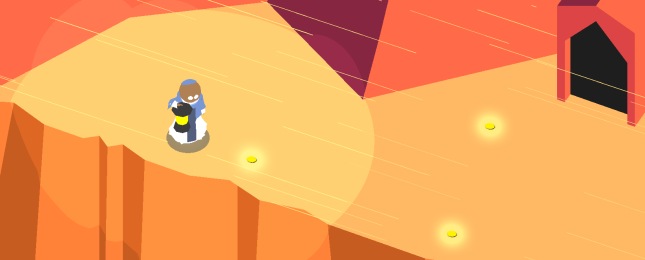
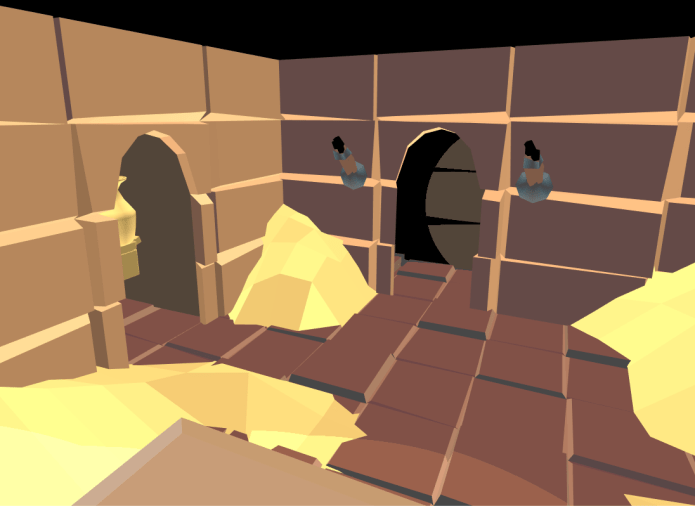
Our new in-game currency, Gold, can be found on the ground during levels.

After downloading the game and completing the first few levels, you’ll notice our new in-game shop module that we’ve been working all morning on. A new currency has been added to the game called Gold. Gold can be found on the ground during levels, and you collect it by simply walking on it (see image above). Of course, it can also be purchased with real money (USD or regional equivalent) if you have a credit card associated with your App Store / Google Play account.
SHOP

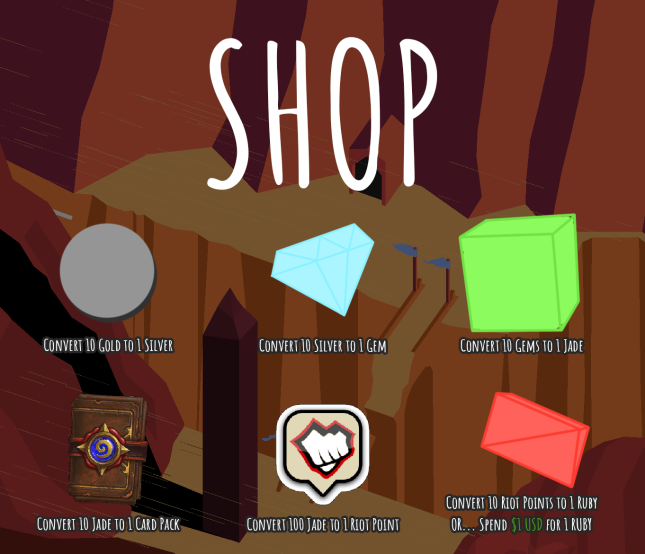
The Shop can be pulled up at any time during the game.

The main purpose of Gold is to buy Silver. Silver is mainly used to buy Gems. Gems are used to purchase Jade, which is the only currency in the game that can get you Card Packs. Card Packs, when opened, have a chance to give you Riot Points. Riot Points are important since they can be used to buy Rubies. Rubies are the main currency the game will be using from now on, as they are used to buy Energy.


Energy – Balancing Player Anxiety and Fun

But what is Energy, exactly? Energy is a new way to play that adds gritty realism to the game. It also adds an important anxiety-checkup cycle to the game that urges players to keep checking their phone habitually to succeed in Where Shadows Slumber.

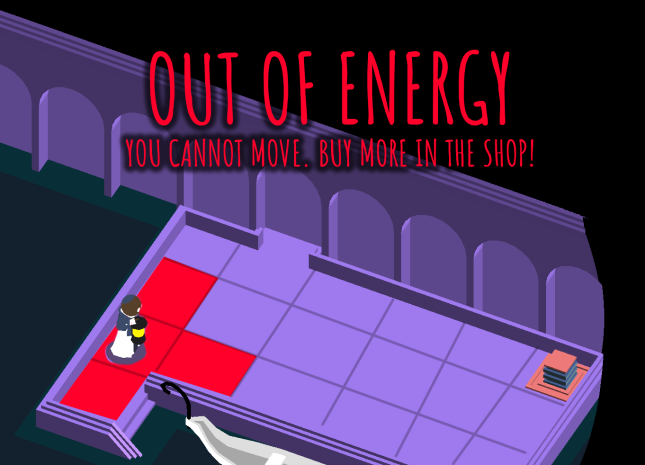
In order to move a single space in the game’s grid-like path-finding system, you need to spend 3 Energy. When solving a puzzle, you need to ration out your Energy. Spend too much time walking, and you’ll run out of Energy for the day.
OutOfEnergy

Never fear, however. Within 24 hours, your Energy bar will be refueled back up to 24, and you’ll be ready for another exciting few minutes of puzzle solving! If you’d like to speed up this process, you can buy Rubies in the Shop.


Challenge Your Friends In Multiplayer

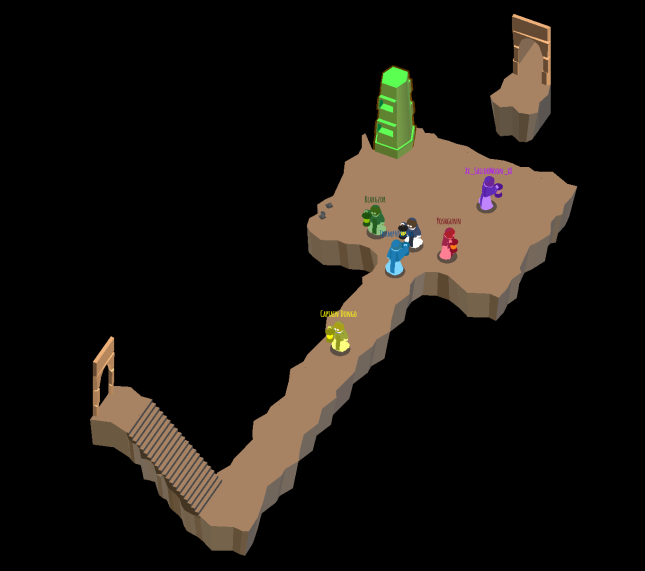
The final piece of feedback we hear constantly is to add multiplayer to the game. We think this is a fantastic idea, so we’re proud to announce that the final game will allow you to solve puzzles with friends and strangers alike! Advances in technology have allowed us to create a real-time multiplayer solution that we hope everyone will enjoy.
Multiplayer

Work with your friends to solve the puzzle, or trap them behind a veil of shadows forever! We hope multiplayer will expand the replayability of the game and the amount of money players invest. We’re also well aware of the criticism that this completely breaks everything about the game’s shadow mechanic, and we are working to remedy that.


We hope you enjoyed taking a look at our bold plans for the future. Our goal is to produce a game that appears free, but costs close to $1,000 to really enjoy. Due to these changes, we expect we’ll have to push the game’s release date back to the year 2020. We appreciate your understanding!


This post was last updated on April 1st, 2017.


= = = = = = = = = = = = = = = = = = = = = = = = = = = = = = = = = = = =

We hope you believed this satirical post! If you’d like the truth, starting tomorrow you can find out more about our game at WhereShadowsSlumber.com, find us on Twitter (@GameRevenant), Facebook, itch.io, or Twitch, and feel free to email us directly with any questions or feedback at contact@GameRevenant.com.

Frank DiCola is a professional Grongus, and the artist for Mass Effect: Andromeda.
Art Spotlight: Cutscenes, Part I

For the past few weeks, Jack and I have been working on transitioning from the Demo Version to the Final Version of Where Shadows Slumber. One of the finishing touches I’m committed to adding to our demo is a short cutscene that plays when you beat the game. Our fans are always asking us if the game will have some kind of a story. The answer is yes, it absolutely will! But the nature of mobile entertainment and puzzle games in general dictates that we tell a certain kind of story in a certain kind of way.


860e6bef748f96c0bfd4d8d5b79626a4

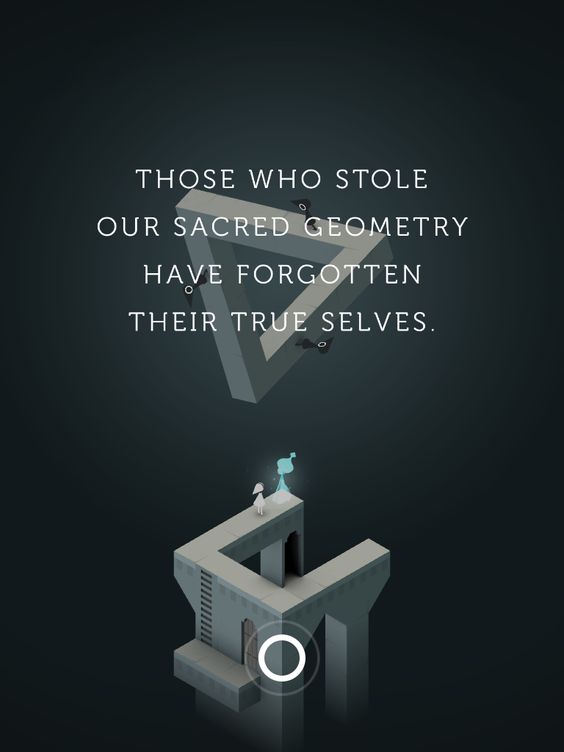
Screenshot from one of Monument Valley’s cutscenes.

Why Cutscenes?

When we decided we wanted the game to have a story, we looked at other successful mobile games (see Monument Valley, above) as well as the games Jack and I usually like to play. It seemed that short cutscenes, placed directly after the player “achieved” something notable, were the best way to hold people’s attention. Jack loves listening to all of the audio books in Diablo 3, and I loved reading entire libraries in games like Morrowind and Skyrim. However, for a casual gamer, massive amounts of text can seem like an information overload. Not to mention, that creates a lot more work for our translator – which translates into a serious cost for us.

It’s also worth mentioning that mobile gamers don’t often play games with the sound on. Clearly, investing our time in fully voice-acted content wouldn’t be worth it. Who would ever hear it? When you think about it, given these constraints, we didn’t have many options.

  1. Mobile gamers can’t hear your game
  2. Casual gamers want a story, but not an epic saga
  3. Mobile gamers play the game in short bursts
  4. The more voice over work and text we have, the more we need to translate

Since the above four points are a given, we decided to have short cutscenes at the beginning and end of every World in our game to serve as end-caps. The action in each of these animated scenes will be completely wordless and textless, and tell a story through body language alone. Sound will be present, but it won’t be important. The cutscenes themselves each tell a unique piece of the story, and may even seem disconnected. This is all by design!


3Ds

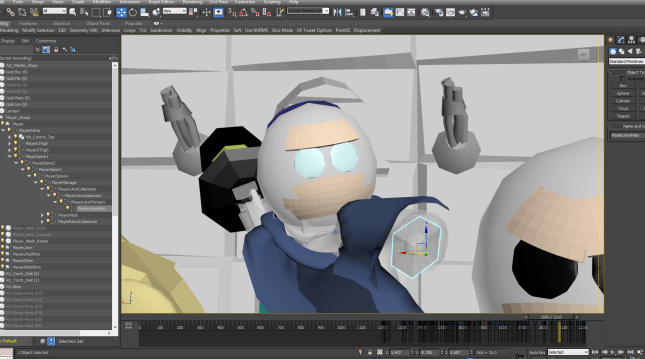
3DS Max is used to animate the actors, and the file is then interpreted by Unity.

The Technology Being Used

All of the artwork in Where Shadows Slumber is done in a program called Autodesk 3DS Max. I’ve used many studios in my years as an animator, but this was one of the first I ever tried and something about it called me back.

3DS Max is used to create characters (modelling), paint them (texturing), give them bones and animation handles (rigging), and make them move around (animation).

Then, these animations play in real-time within Unity. So when you’re watching a cutscene, you’re really watching the game – not something that was rendered ahead of time as a series of images and played back like a film. It was important to me that we use Unity to its full potential, and always kept players “in the game world”.


regret

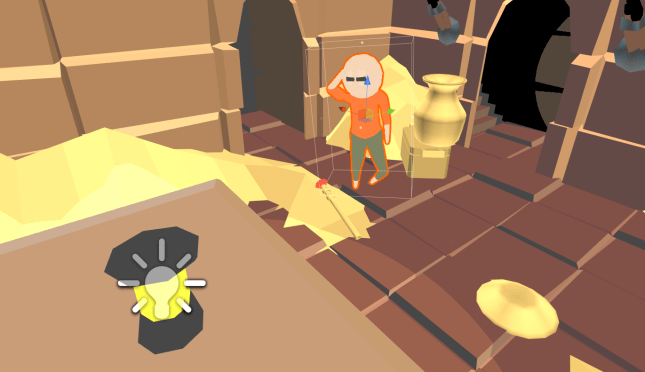
Within Unity, the actors are given color and lighting.

Process: The Inverted Cone of Cutscenes

When working on a large project like this cutscene, it’s important to work in stages and have clear checkpoints. And make no mistake, even a cutscene that is 1 minute long is a large project! I have spent close to 30 hours on it so far, and I’m not even finished. The problem with stuff like this is that if you want to change something, usually you have to undo or throw out a ton of work. It’s important to make sure that doesn’t happen, and that you start with a wide range of possibilities but eventually focus in on what the cutscene is going to be.

For some insight into how a cutscene begins wide and then narrows to completion, look at this graph:

CutsceneBlog

The further you go down the inverted cone, the more work you lose if you change something.

See the arrow – I am currently at the end stage of Principal Animation. That means the actors all have their general motions and you can tell what’s going on in the scene. But it still isn’t finished! Look at all of the other stuff that has to be done.

The reason things like cloth motion and sound come last is because, should we decide to change some of the Principal Animation, we would have to throw out all of that “detail work” anyway. So it just makes sense to save it for last and only work on it when the work at the top of the cone has been checked and locked.


skirt.PNG

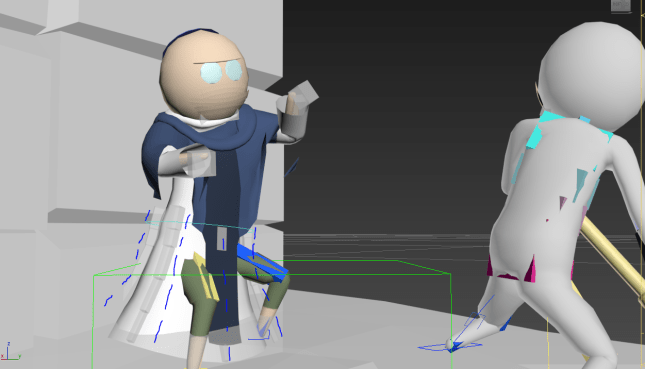
The player’s cassock (the white tunic) is animated using 30 individual bones!

Regrets So Far

You don’t work on a game without having some serious regrets. Every regret I have so far regarding this process has to do with time – something I did, did poorly, or did not do, that cost me precious time and made us push our deadlines back.

Giving the character cloth robes: I love robes. I love cloth. But I foolishly decided to give our main character cloth robes that must be painstakingly controlled via spider-leg-like bone tendrils. This process is maddening, takes forever, and never looks good. I regret not using Cloth simulation, something 3DS Max provides and Unity supports.

His dumb hand bones: This is something you would never know from watching the in-game cutscene, but the main character’s hand Bone (an invisible puppet-string object) is stupid, dumb, too big, and I don’t like it. I should have made them smaller. Also I think his left arm bends the wrong way. Let’s just say I ought to re-do his entire rig.

Link To World broke everything: I used a parent-child relationship to allow the characters in the scene to hold objects (i.e. the lantern, the urn, the chest, the scepter, the bowl). This worked perfectly! Except… for some reason, the first time I set up linking on my character’s IK hand setup, it wigged out and sent his hands flying off screen for every single frame of animation I had done previously. This was clearly some kind of offset error, but I never found a good solution. I ended up reanimating his hands halfway through!

People would rather have more levels anyway: The sad truth is, this is a puzzle game. People want puzzles. (“More levels!” – The Proletariat) As much as they may say they want a story, the truth is we’ll get more mileage out of working hard on puzzles instead. It may be that the cutscene is there for a different purpose. My own ego? Winning artsy indie game awards?

Everything mentioned here made me lose time and work on this far longer than I should have, making us weeks (if not months) behind schedule for a demo that was supposed to be done already. Perfect is the enemy of good enough! Live and learn, right? That’s the beauty of working on a demo first. I now know what not to do for the final game! Let’s just hope the damage hasn’t already been done by now.


Next Blog Post

By the time I have to write Part 2 of this blog, I should be finished with the cutscene. I can show it to you in full and we’ll do a bit of a postmortem on it. I can give you the short version of the postmortem now: the cutscene is a lot of work, there’s very little payoff (I assume), and the subject matter is controversial. Nevertheless, here’s a sneak peek at it to tide you over until then…


= = = = = = = = = = = = = = = = = = = = = = = = = = = = = = = = = = = =

Interested in hearing about the game, now that you’ve peeked behind the scenes? You can find out more about our game at WhereShadowsSlumber.com, find us on Twitter (@GameRevenant), Facebook, itch.io, or Twitch, and feel free to email us directly with any questions or feedback at contact@GameRevenant.com.

Frank DiCola is the founder of Game Revenant and the artist for Where Shadows Slumber.

3 Things I Learned at GDC 2017

I’ve just returned from a whirlwind trip to this year’s Game Developers Conference (GDC), and I have a lot to tell you! Unfortunately, most of what I learned is top secret. You hear a lot at these conventions, so between secret news and talks with undisclosed mobile publishers there isn’t a lot I can disclose. More on that later this year…

But I can certainly reveal my impressions as a first-timer to help you out if you’re planning on going to GDC 2018. Here are three things I learned my first time at GDC!


Calendar with pushpins

Lesson 1: Schedule Meetings Months Ahead of Time

My number one priority at GDC 2017 was to talk to someone from the App Store about Where Shadows Slumber. My number two priority was to talk to someone from Google Play. Specifically, I’m looking for the people that make promotions and “features” happen. Being featured on an app marketplace can sometimes be the difference between relative obscurity and worldwide fame. It’s that important.

Certainly it can’t be your only strategy, but it’s at the top of my list. Sadly, I failed! Since I was so late to the game (I only found out about GDC when two people mentioned it at MAGFest 2017 earlier this year) I never scheduled times to meet with them. Naively, I assumed there would be some kind of Apple booth and I could meet them there.

No way. Although the major players (PlayStation, Oculus, Facebook, Microsoft, Unity) had large presences at the show, Apple did not have a booth. They probably assume they would just get inundated by indies and it wouldn’t be worth the expense. If you wanted to talk to them, you had to get on their calendar months in advance. They met with business partners in secret rooms during the show, protected under heavy guard. The same is true for Google – they had a booth, but it was specifically to show off Daydream, their mobile VR peripheral. The Google Play team was nowhere to be found.

I learned the hard way – don’t make my mistake! It’s crucial that you do your homework ahead of time and get on the calendar of a major player like Apple, Google, Nintendo, or whoever you want to meet. Don’t leave this stuff to chance!


20170303_101342

GDC talk about Chinese localization pitfalls, given by Jung-Sheng Lin of Taiwan.


Lesson 2: The Talks Are Great, But You’ll Get Tossed Out

I went to GDC primarily to make connections in the industry. I wasn’t expecting to enjoy the seminars as much as I did. It turns out there are a lot of talks, panels and seminars at GDC and they run the full week. (I arrived on Wednesday, since I was mostly concerned with the Expo – but there are talks and parties beginning on Sunday) The lectures were great! I enjoyed pretty much every one that I went to. The panels weren’t as interesting as the talks because less work went into preparing them. But overall, I was impressed.

One thing bugged me though. I should have seen this coming, but when you buy a pass for GDC you’re effectively selecting what access you’ll have during the show. They have all kinds of “tracks” – Art, Music, VR, All Access, Mega Golden God Status, etc. I got an Expo Pass, which is the cheapest option. This lets you into the Expo and a small smattering of talks.

What this meant was that often I would see a talk advertised (“Nintendo Reveals All About Breath of the Wild!”) and get really excited for it only to be turned away at the door. The paper pocket guide doesn’t warn you about the access required for a talk, it just says where the talk is and who is giving it. To see a filtered view, you need the app. Once I filtered the talks available by the Expo Pass using the GDC app, it become clear that there really wasn’t too much I was interested in. Fortunately I snuck into at least one restricted talk (it was about early access and Ark) and the talks I was able to get into were pretty good. Still, it’s a bad feeling.

So, again, plan ahead! Before you buy a badge, look at the talks available. Filter the list. Ask yourself – are the seminars worth the price jump from $299 to $999? If so, take the plunge. You’ll appreciate getting the access. Otherwise, just deal with the consequences and don’t be surprised when ushers show you the door.


20170307_134433

Lesson 3: Don’t Take No For An Answer

The theme of the first two Lessons is quite clear: plan ahead. Having said that, I should also mention that just because you didn’t plan ahead doesn’t mean you shouldn’t muscle your way in anyway.

Rules only matter if they’re enforced, right? Once they stop being enforced they might as well not even apply. Although I don’t believe this is true when it comes to objective morality (don’t go burning down houses because you think you’ll get away with it), it certainly works when it comes to event admissions.

For example, I went to the Big Indie Pitch at GDC 2017 after some urging by Craig Barnes (I owe you one, man!). This is a pitching contest where you show your mobile game to publishers and industry professionals. You get 4 minutes with 5 different groups each, and they judge your game based on its aesthetics, mechanics, marketability, and overall quality. But I never formally applied for the contest because I missed the submission cut-off by one day. Feeling dejected, I almost didn’t even attend! It was 3 pm on a Thursday, I was already exhausted, the event wasn’t close to the convention center, and I very nearly bailed to go to other events instead.

Something told me I’d regret it if I didn’t at least show up, so I took an Uber over. As the event began, I begged the event coordinator Simon Drake of Steel Media to put me on a Waitlist. If people didn’t show up, I could take their slot! There were four others like me so Simon agreed, and to our surprise the Waitlisters were given a chance at the tail end of the contest to make our case to the judges. (OK, this isn’t really “muscling”, more like “pleading”… but you get the point!)

To my utter shock, Where Shadows Slumber received third place at the Big Indie Pitch! Jack and I now have $1,000 in marketing money to use on any of Steel Media’s owned platforms, and we’ll put it to good use. Another awesome thing: the second place winner, Louard of Suzy Cube, was also on the Waitlist! The moral of the story? Plan ahead, and plan for everything.

Then, expect your plans to go wrong, and don’t give up when they do!


I’m going back to GDC next year for sure. We may exhibit at the show, or just walk the show floor. I definitely want Jack to see this, because it’s an awesome experience. Where Shadows Slumber will hopefully be commercially available by GDC 2018 so the timing should be perfect… but you know what they say about plans.


= = = = = = = = = = = = = = = = = = = = = = = = = = = = = = = = = = = =

Were you at GDC 2017? Tell us about your experience in the comments below! You can find out more about our game at WhereShadowsSlumber.com, find us on Twitter (@GameRevenant), Facebook, itch.io, or Twitch, and feel free to email us directly with any questions or feedback at contact@GameRevenant.com.

Frank DiCola is the founder of Game Revenant and the artist for Where Shadows Slumber.

Heading to GDC 2017 Today!

As I type this, I’m packing to go to GDC 2017 – The Game Developers Conference at the Moscone Center in San Francisco, California. The convention actually already started, believe it or not. Monday and Tuesday are incredibly expensive lectures and talks, with an expo that runs Wednesday through Friday.

Since I’ve never been to this before, I didn’t want to break the bank. Transportation to San Francisco was expensive enough, especially when you consider I’m staying in a hotel near the convention center. So I’m just going to the expo, where indie devs will be showing off their games and large companies will be holding meetings with business partners.

I have three main goals in mind for GDC 2017: scope out the convention for 2018, meet publishers and distributors, and plan the future of my company.


gdc

Case The Joint for 2018

This is a huge show, and it always happens right around this time of the year. I predict Where Shadows Slumber will be released at some point next year during this time, so it’s highly likely we’ll be attending GDC 2018 as exhibitors.

I want to ask these indie devs if they feel like it was worth the price, the trip, the time, and other costs. You never know which shows are going to give a return on your investment. This also gives me a convenient excuse to actually have fun at a trade show!

I’m so used to going to these things as an exhibitor, I forgot what it was like to be able to freely move about the show floor and talk to people. What a treat!

Also I need to make sure I get details on how to sign up for contests. GDC has a few award shows that run (two, I think?) and I know next to nothing about them. But I know that I want Where Shadows Slumber to win everything forever, so it’s time to get some information. I’ll return next week with contact people!


idreamsky


Meet Publishers and Distributors


It can be difficult to make a connection to someone completely online. But Jack and I need people to distribute our game in China, Japan, Korea, Russia, India, and other foreign countries. We don’t speak the language or understand the market. For a cut of the proceeds, these publishers can make our game a hit in their region.

I’m not looking to promise these people anything just yet. Mostly I want them to take a look at the game and get a conversation going. If the game is “on their radar”, then my follow up email over the summer might get noticed.

But first they need to see it. I’ll shove my iPad in their face if I have to! (I swear to God I will do this once before the show ends) I already have a hit list on my phone of who I need to hunt down at GDC, and I won’t rest until I find them!

This took a violent turn… so let’s go to the final section!


maxresdefault

Plan For The Future

I already talked about GDC 2018, so why do I need to plan for the future? Well, you can’t work on one game forever. Even Blizzard will need to say goodbye to its beloved properties one day. Where Shadows Slumber is a beautiful game, but I have a lot more game ideas in the pipeline. Planning for what comes next is important. We may be talking as far as 2019 or 2025 here, but I plan to build this company into something great. That takes foresight.

I want to make a good first impression with some big-wigs at the largest game companies and bluntly ask them what it takes to make third-party games. There’s a lot of exciting stuff happening around VR (which I am still skeptical of), Nintendo’s Switch, and the growing PC gaming market. Now is the time to forge some professional bonds to be used at a later date. There are some technology companies in particular that I want to visit, so I can ask them some “is this possible with your tech?” questions.

I’ll try to do a recap of all this when I return, but PAX East is next week so… gah! It’s going to be a busy life, I suppose >:)


I have a taxi to the airport to catch, so see you next time! Thanks for reading.


= = = = = = = = = = = = = = = = = = = = = = = = = = = = = = = = = = = =

Don’t miss updates while I’m at GDC. Share our game at WhereShadowsSlumber.com with the GDC hashtag, find us on Twitter (@GameRevenant), Facebook, itch.io, or Twitch, and feel free to email us directly with any questions or feedback at contact@GameRevenant.com.

Frank DiCola is the founder of Game Revenant and the artist for Where Shadows Slumber.