State of the Art – August 2018

Welcome to the State Of The Art, August 2018 edition! This monthly progress report is written by Frank DiCola and is focused entirely on how the game’s visuals have improved in the past month.

Missed last month’s State of the Art? The July edition is right here.


For Our Eyes Only

A quick note, before we dive in… since this is the final State of the Art, it’s going to be a little bit underwhelming. Sorry about that! The game is so close to being finished that Jack and I don’t really want to release any more images or footage until Where Shadows Slumber is uploaded onto the App Store. In the past, journalists have accidentally used our old images of previous builds (including our 2016 Demo!) in their articles instead of new stuff. For that reason, we’re trying to put some distance between our progress related uploads and the launch of the game.

If you were lucky enough to visit us this past weekend at Play NYC, you got a chance to play the final pre-release build of the game! As you would have seen, all of the art is totally done with the exception of a few cutscenes that need some polish. We brought a build that had every Level and Cutscene in the game, so we got a chance to see people play every part of the finished build. Two brave souls even dedicated a few hours (across both days) to finishing the entire game! So even though there are no new images in this article, rest assured that this is a good sign of progress, and not a bad sign that I’ve been sitting on my hands the past 6 weeks!

Thank you so much for following this blog, and I apologize for the lack of juicy spoiler images. You’ll have to wait until the game launches on iOS and Android later this year to feast your eyes on the beauty that is Where Shadows Slumber. Until then, enjoy these sweet black rectangles!



Black

Art, Then and Now

The last State of the Art was written on July 3rd. At the time, the only pieces of art left to do were the game’s last four cutscenes – World 5, World 6, World 7, and an animated Credits sequence. Small artistic touch-ups were needed across the game’s many Levels, as well as a few art related bugs.

Those last four cutscenes are all nearly complete. I say nearly because, since time is of the essence, I animated them just far enough so that our wonderful audio team could take over and begin creating sound effects. Today, in an effort to finally finish the game, I’ll put the last little details into these scenes. These details include things like snowy footprints or rustling trees – background information that isn’t necessary, but helps to paint a better picture of the scene. I know Jack is eager to crunch every Level and Cutscene so we can have a fully 100% optimized game, so right now it’s more important to call these scenes done than to obsess over the details. I shall spend not one more day on them!

Other than that, there are some release prep things I still need to do. I try to focus on tasks that involve other people first, which means I put off some solo projects like the game’s app icon, app preview video, press kit, and our release date announcement trailer. We’re not announcing our release date yet, but [spoiler] when we do it will be in the form of a cool trailer! We’ve heard that’s the best way to generate buzz for the game. Hopefully our efforts these past 2 years to “pre-market” the game mean that when the trailer hits YouTube there is a large group of fans eager to share it around social media.


Black

Thoughts on The Ending

Soon, I will stop being the artist on Where Shadows Slumber and become Mr. Bug Finder. Then, in the weeks before the game hits the App Store, I’ll be Mr. Marketer. After that, I’ll be Mr. Salesman as I go on the Extremely Real and Actually Real Where Shadows Slumber World Tour! (Buy our game so we can do this)

It’s so strange to think that in just a few days, I won’t be modeling environments or animating these characters ever again. Saying goodbye is a bit of a relief, but it’s also disturbing. It feels a bit like leaving a job at a company without having another one lined up. And I’m not talking about the financial success of the game (we have no idea what to expect… $500? $500,000?) but rather my own personal sense of purpose. I never thought I would feel totally lost right at the moment our three year passion project is about to hit prime-time. Is this normal? How am I supposed to feel?

Anyway, this is the State of the Art blog, not the State of Frank’s Mind blog. Let me save my goopy tell-all for a podcast appearance with Jack sometime. (Speaking of which, even if you have the tiniest, most insignificant YouTube channel or podcast, invite one of us on! We love to talk! Contact info in the signature below) All you need to know right now is that the art is 98% finished and we’re heading into our final Quality Assurance (QA) stretch.

Stay tuned to this blog for mega updates about the game, tales from QA hell, and maybe even a comedic play-by-play of our upcoming Xcode struggle. Thanks to Jack for giving me a good name for this blog, and thanks to everyone who has been keeping tabs on us. I may resurrect this monthly recap if we have new art updates, such as when we port the game to Amazon’s Alexa, but right now I’m looking forward to wearing a different hat for a while.

See you next week!


= = = = = = = = = = = = = = = = = = = = = = = = = = = = = = = = = = = =

Thanks for reading this entirely text-based art update! If you’re new to this blog, you can find out more about our game at WhereShadowsSlumber.com, ask us on Twitter (@GameRevenant), Facebookitch.io, or Twitch, and feel free to email us directly at contact@GameRevenant.com.

Frank DiCola is the founder of Game Revenant and the artist for Where Shadows Slumber.

Join Us At Play NYC 2018!

The team behind Where Shadows Slumber is thrilled to announce that we’ll be returning to Play NYC this weekend (Saturday August 11th and Sunday August 12th) for its second year in operation. Play NYC is a massive game convention that takes place right in the heart of Manhattan, and welcomes game developers from all around the Tri-State area to show off their work.

Play NYC has grown a lot over the past year – the event will now be held at The Manhattan Center, and over 100 exhibitors are expected to showcase 140+ games over the course of the weekend. However, one thing has not changed: though Play NYC 2018 is only in its sophomore year, it has quickly become New York City’s premiere indie game event. We can’t wait to meet more fans and show you how far the game has come!

If you haven’t purchased tickets yet, hurry up and buy them! Note that you can only pick up tickets for a portion of each day, not an entire day. Since Play NYC isn’t a 4-day event like PAX East, Playcrafting decided to split each day into 5-hour chunks of time to simulate the 4-day experience.

As developers, we love that. There probably won’t be any slumps during this weekend at all. Generally at these conventions, there are periods where the attendees have seen everything they are interested in, and you have a good hour or two with no foot traffic. I don’t think that will be a problem! I’m not sure how the public will react to this setup, but I hope attendees enjoy the show regardless. Personally, I think 5 hours should be plenty of time if you are coming to Play NYC for the first time and you just want to see what it’s all about.


Image-6 Exhibitor Ad.jpg

Play NYC In The News

Many prominent journalists are covering Play NYC, which is another thing Jack and I find so appealing about the show. The event itself is a big deal, which means it should attract even more journalists who want to write about underground games made by independent teams.

Here’s a few links to some articles about the event:

We got a shout-out in TechRaptor’s promotional Play NYC article.

The New York Times wrote an article about the difficulties game developers face in NYC.

The New York Times also created a list of 12 cool games made in NYC.

Variety wrote about Play NYC’s efforts to highlight immigrant developers.

I hope those articles whetted your appetite, and you’re looking for more. (Too bad we didn’t get into that list of 12 cool games… I guess Hoboken doesn’t count as NYC!) If you came to Play NYC last year, you already know how awesome it is going to be. We hope to see you there.


Play-NYC-2018_Main-Floor.jpg

Come See Us!

If you take a look at the image above, you’ll find us on the top-right in teal. Booth 22 (Game Revenant) is us! If you read this blog regularly, please come visit us and say hi [^_^] We may even whisper the release date in your ear and force you to swear a vow of silence…

This will likely be our final event before the game launches to the wider public on iOS globally, so it’s going to be our swan song to development. This is the calm before the storm. That also means that if you want to show Where Shadows Slumber to a friend before it releases so you can score cool friend who knows about indie stuff points, you better bring them to our booth!

Of course, if you can’t make it to the event, you can always watch the Twitch stream!


= = = = = = = = = = = = = = = = = = = = = = = = = = = = = = = = = = = =

We hope to see you at PLAY NYC 2018! If you’re new to this blog, you can find out more about our game at WhereShadowsSlumber.com, ask us on Twitter (@GameRevenant), Facebookitch.io, or Twitch, and feel free to email us directly at contact@GameRevenant.com.

Frank DiCola is the founder of Game Revenant and the artist for Where Shadows Slumber.

The Good

In order to figure out what I was gonna write about this week, I took a quick scroll through the past few posts we’ve written, and I noticed something about the general tone of our blogs of late. Thanks to the pressure to get Where Shadows Slumber done, and the fact that we’ve entirely run out of new ideas for blog posts, everything we’ve written recently seems to have fallen into one of two camps:

  • A half-hearted explanation of a part of the game no one really wants to hear about, because we can’t afford to waste time writing blogs when we have work to do.
  • A frantic excuse for why the game hasn’t been released yet, which generally boils down to “working on this game is sucking out my soul”.

Even those descriptions fall into one of those categories! (Hint: it’s the second one). That fact aside, I’ve decided to take it in a different, more positive direction this week! Instead of talking about how much game development sucks, let’s talk about all the good that’s come from working on Where Shadows Slumber.


Lessons Learned

The first and most obvious positive result of working on Where Shadows Slumber would have to be the things that I’ve learned. Creating an entire game from the ground up in a game engine that I didn’t have much experience with has been incredibly challenging, but it has also left me with a lot of new knowledge and valuable experience.

Blogging

I’m still not the best coder on the team. That honor goes to Obe.

  • Unity itself. Unity is a very powerful, and professional, game engine. It may not have all of the depth of something like Unreal, or all of the customization of writing your own engine from the ground up, but there’s really no arguing that it’s not a “real” game engine. In fact, there is now a certification for programming in Unity.


  • C#. As a programmer, you get pretty used to picking up new languages, and, for the most part, it gets easier with every one you learn. The fact that I was able to learn C# isn’t the takeaway here – the fact that I was motivated to learn C# is. Without Where Shadows Slumber, I simply wouldn’t have had any reason to extend my programming repertoire.


  • Shaders. One of the most difficult technical challenges this project has posed has been the shaders. For the most part, the programming required for the actual game logic was similar to code I’ve written before. Shaders, however, delve into a very different type of programming. I now know far more about how Unity renders a frame than I ever thought I would, and I’m pretty happy to have that knowledge. Even if I don’t have to do any rendering work again, I’m glad to know what’s happening under the hood.


  • Project management. To continue a running theme throughout our blog posts, I’ll mention that this was the one that took me by surprise. When this project started, I was well aware of (most of) the technical challenges that lay ahead. What I didn’t anticipate was handling the vast array of tasks involved with actually managing a project. Where Shadows Slumber has helped me advance from a quintessential disorganized coder all the way to a slightly-less-disorganized coder!


There are a million other, small things that I learned throughout the production of the game, but these are the big ones. Throughout its development, Where Shadows Slumber has had a lot to teach me!


Personal Life

Another important (and perhaps more poignant) side-effect of working on Where Shadows Slumber is the personal relationships that it has helped cultivate.

17159203_1817437325174646_6524966612565150056_o

BFFs Forever!

Frank and I were friends in college, but just barely. We were in the same sketch comedy group, but outside of that, we didn’t really hang out. I guarantee that if it weren’t for Where Shadows Slumber, we wouldn’t be in contact at this point, and it probably would have been several years since we’d seen each other. Now, however, we’re definitely friends, and close friends at that. Frank and I are in nearly constant contact, which, annoying as it can be, keeps us pretty close. I don’t want to bore you by getting too gushy, so let’s just say that we do a good job of tolerating each other.

In addition to bolstering an existing friendship, this project has also created new friendships – with Alba and Noah, our sound engineers! They’re totally awesome, and I look forward to spending more time with them, hopefully even after we’re done with Where Shadows Slumber!

We may not be as close, but the other people that we’ve gotten to know are all of you! As an indie game, we have to do a lot of work to make sure people hear about the game. Throughout the past few years, we’ve been to over a dozen conventions, showcasing and pitching the game, making a name for ourselves, and, most importantly, meeting a bunch of really cool people! Seriously, all of the people we’ve met throughout this process, whether they be other game developers, fans, or just normal con-goers, are great. No matter if I’m annoyed with the game or frustrated with the drudge of development, going to a convention and seeing new people playing the game, or old fans coming back to check in, is always incredible. There are a lot of aspects of Where Shadows Slumber that I love, but that’s definitely the best part.


The Game Itself

I guess the actual most obvious result from Where Shadows Slumber would be the piles and piles of money we’re going to make from it. That, however, is not the point – as much as I would love for Where Shadows Slumber to make some money, that’s really ancillary to the whole ethos of the project.

Frank and I are avid gamers, and always have been. We set out not to make a lot of money or make the most popular game ever. We wanted to create something beautiful, something we could be proud of – and in that sense, I think we’ve done a pretty good job. When I look back on this project, I’m not going to look at my net profit – I’m going to look at Where Shadows Slumber itself, and I think I’ll always be happy with it.

trophy

I think we’ve got a chance at this one!

Of course, Where Shadows Slumber will serve as more than just an ephemeral trophy to put on my emotional mantle. The game itself is the end goal here, and there are some tangible benefits to that:

  • Money. Even though this isn’t the goal of the project, Frank and I are both hoping to make a little something for our efforts.


  • “Resume bait”. At some point in the future, I expect that I’ll be looking for a job. When that time comes, I’ll be handing out my resume, hoping to catch the eye of some company. But I may be just one of hundreds of applicants, all with similar experience and qualifications. How can I stand out? By having something awesome on my resume, something that other people won’t have, something that shows that I can set a goal and reach it, that I can meet technical challenges, and that I can manage a development process.


  • Experience. Working on Where Shadows Slumber has given me an incredible cache of experience to draw on. Pretty much any technical problem I run into, I can find a parallel with some part of the development of Where Shadows Slumber. The end result is a game that’s more than a game; every part of that game represents a different challenge and a different piece of knowledge that I can now look back on.


  • A trophy. I know I said that Where Shadows Slumber was more than just a trophy, but it is also that. From conception to completion, Frank and I have worked tirelessly to bring this idea to life. This is something we’ve built ourselves, from the ground up, and it always will be. It’s something we can be proud of, and something we can always look back on.


A Fond Farewell

happy3

Thanks for listening to me ramble on for a little bit. Anyone who has ever worked on a software development project (or pretty much any long project) knows just how stressful life can start to become when you reach the dreaded “crunch time”. We all end up hating our games as they come out, and I don’t want that to be the way that Where Shadows Slumber is released. So I’m glad I got a chance to take the time and share with you all the good things Where Shadows Slumber has done for me!


= = = = = = = = = = = = = = = = = = = = = = = = = = = = = = = = = = = =

You can always find out more about our game and how awesome it is at WhereShadowsSlumber.com, find us on Twitter (@GameRevenant), Facebookitch.io, or Twitch, join the Game Revenant Discord, and feel free to email us directly with any questions or feedback at contact@GameRevenant.com.

Jack Kelly is the head developer and designer for Where Shadows Slumber.

All About App Icons

As the completion date of Where Shadows Slumber draws near, Jack and I are coming to terms with just how much work it takes to finish a game. This means we’re revisiting old tasks that we didn’t have to deal with for a while, including the game’s app icon.

It may seem like a small detail, but your game’s icon is very important. It isn’t exactly the same as your game’s logo, but in certain contexts it plays the same role. The app icon is the rounded square button on your customer’s phone menu that they have to press to start playing your game. More importantly, this icon is on prominent display on marketplaces like the App Store and is often a potential customer’s first impression of your game.

Viewed through that lens, the app icon is immensely important and I regret not working on it sooner. It’s just a small graphic, though… how difficult could it be?

Fortunately, I’ve been researching this topic for a little while now. Below, I’ve compiled a gallery of some of my favorite app icons. We’ll also discuss in this blog post my personal “do’s and don’ts” for these graphics, inspired by both previous iterations of the Where Shadows Slumber app icon.


Inspiring Icons

I played a lot of mobile games during the creation of Where Shadows Slumber. That’s not because I’m lazy! I wanted to see what successful mobile games did. I spent a long time looking at their store listings, reading reviews, poring over their descriptions, and – of course – checking out app icons. It wouldn’t be a Where Shadows Slumber blog post if we didn’t gush over Monument Valley, so let’s start there.

AppIcon-Monument-Valley.JPG

The app icon for Monument Valley is really beautiful and shows off what the in-game art looks like. When you look at the icon on your device, the scale of Ida here probably matches her scale in the game. That makes this graphic one of the most honest app icons in the business! From a distance, you can clearly make out her shape because her white body contrasts starkly with the green backdrop. I also love that this picture shows the isometric angle and color shading that they use in the game. Sadly, this image does not communicate the game’s M.C. Escher inspired puzzles… but how the heck could you even show that? Maybe I shouldn’t worry too much about showing “shadow puzzles” in a tiny square image. It would just never fit!

AppIcon-Monument-Valley-2

The app icon for Monument Valley 2 was constrained somewhat by the first. The artist likely felt the need to match the style of the previous icon. Now that they’ve got a pattern established, expect to see something like this if they ever make Monument Valley 3. Still, the fact that this icon communicates the relationship between a mother and daughter tells you a lot about the game’s story and mechanics.

AppIcon-Sneaky.png

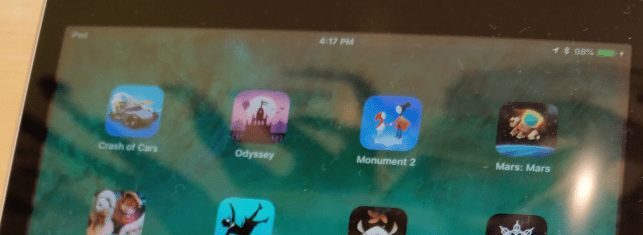
The real reason I bring up Monument Valley 2 is because of something I noticed when I was in an Apple Store the other day, getting a new iPad for my Dad. On their demo devices, the game is labeled simply as “Monument 2,” because the name is too long. Notice also that the game Alto’s Odyssey is just named “Odyssey.” I’ve wondered what Jack and I should do with our lengthy title Where Shadows Slumber… should it be listed as “Slumber,” “Shadows Slumber,” or “Shadows?”

AppIcon-AltosAdventure

Speaking of Alto’s Odyssey, both games in the Alto series have very beautiful app icons. However, it seems to me that the original is better because it actually communicates the mechanics of the game. Take a look at the icon above, and then look at Alto’s Odyssey below. Remember that these games have identical gameplay: both are side-scrolling snowboarding simulators. Notice anything?

AppIcon-AltosOdyssey.JPG

Alto’s Odyssey doesn’t have an image of a dude flipping over a windmill like the first game did! That’s pretty important because the whole game is about jumping over stuff, getting airtime, and doing tricks. But when I see the icon above for Alto’s Odyssey, I imagine a different game where I can actually go into some of those ruins or fly in that hot air balloon. It doesn’t set up expectations the way you might expect. Even so, the image is gorgeous and communicates the art style faithfully.

AppIcon-Prune

Of all the games I researched, my favorite app icon is probably the one for Prune. Look at this beautiful picture! Since I played the game, I happen to know that this app icon is actually a perfect rendition of what every Level looks like, too. Now that’s honesty! Prune is a game where you swipe away branches from a tree to help it grow the right way. I think you wanted to avoid the big red suns because they killed your tree. It’s a beautiful game, and the simple nature of this app icon does it justice.

We’ve looked at a lot of great artwork, but I don’t feel like comparing them to a list of “bad examples” in this blog post. I feel uncomfortable putting down other people’s work besides my own. There is no point in searching the App Store for apps that performed poorly and then ripping their icons apart. Instead, let’s just criticize the two icons I made earlier in the project cycle!


AppIcon-Gallery.png

Learning From My Mistakes

If you’ve ever played our free iOS Demo before, or if you are one of our beta testers, or even if you’re just a diehard follower of this blog, you’ve seen one of our app icons before. We aren’t going to use either of these for the final game’s release, so I’d like to write about them in this space.

AppIcon-WSS-2016.JPG

Our first app icon was created just for the Demo. I whipped this up in Adobe Illustrator over a year ago. The idea was to show a silhouette of Obe in a doorway, with the lantern clearly visible. Looking back on it now, this fails for a variety of reasons:

  1. This image is very detailed, so the intricacies are hard to make out at small sizes
  2. This icon requires pre-existing knowledge about what Obe looks like
  3. The lantern looked weirder back then, so it’s not immediately recognizable
  4. This looks like an icon for a horror game, almost like Amnesia for mobile phones
  5. This doesn’t really look like the art in the game at all
  6. This doesn’t really look like an app icon for a mobile puzzle game
  7. This is misleading because Obe’s body never actually casts shadows

I’m not saying I hate it or I regret making it – it seemed cool at the time! Our Demo drew in over 310,000 free installs on Android alone, so we did something right. But I wouldn’t go for this kind of style for the final game. It’s too much of a departure from the real game’s art, tone, and genre.

AppIcon-WSS-2017

Our next app icon was made much faster and was basically an unofficial app icon. I just did this for the beta, and I didn’t put much effort into it. This one fails on two levels – first of all, it’s not very unique or inspiring. It’s just text. Anybody could make this, and it tells customers nothing about our game. Second, it includes English text. That means I’d need to make a different app icon for every language we release the game in! Why bother doing that when I can just create a cool image like ustwo did?

So for the game’s final icon I need one square image that contains no text, but communicates the following to the player:

  • The game’s reflective tone, with some ominous terror looming in the periphery
  • The game’s crisp light shading model
  • The importance of the lantern to the story
  • The idea that this is a puzzle game and not some other genre
  • The idea that this is a mobile game
  • A warning that this game is not for preteen children

Yikes! Wish me luck. I’ll take a shot at this during the week, in between animating the game’s remaining cutscenes and putting out other fires. Jack and I have spoken about our app icon informally in the past, so I have a pretty good idea of what we want. This analysis helped me crystallize my plan going forward.

We’ll have some exciting news to announce in the coming weeks, so stay tuned to this blog and thanks for reading!


= = = = = = = = = = = = = = = = = = = = = = = = = = = = = = = = = = = =

We hope you enjoyed this update about the game’s graphic design. Have a question about aesthetics that wasn’t mentioned here? You can find out more about our game at WhereShadowsSlumber.com, ask us on Twitter (@GameRevenant), Facebookitch.io, or Twitch, and feel free to email us directly at contact@GameRevenant.com.

Frank DiCola is the founder of Game Revenant and the artist for Where Shadows Slumber.