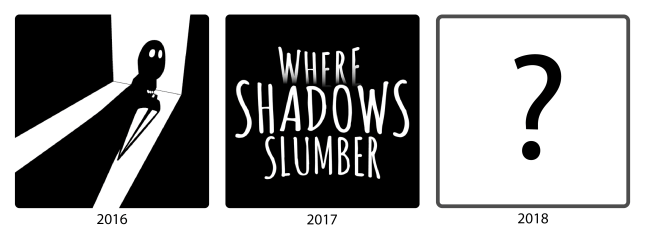
Something is Coming…


= = = = = = = = = = = = = = = = = = = = = = = = = = = = = = = = = = = =

That’s all for now. If you’re new to this blog, you can find out more about our game at WhereShadowsSlumber.com, ask us on Twitter (@GameRevenant), Facebookitch.io, or Twitch, and feel free to email us directly at contact@GameRevenant.com.

Frank DiCola is the founder of Game Revenant and the artist for Where Shadows Slumber.

State of the Art – August 2018

Welcome to the State Of The Art, August 2018 edition! This monthly progress report is written by Frank DiCola and is focused entirely on how the game’s visuals have improved in the past month.

Missed last month’s State of the Art? The July edition is right here.


For Our Eyes Only

A quick note, before we dive in… since this is the final State of the Art, it’s going to be a little bit underwhelming. Sorry about that! The game is so close to being finished that Jack and I don’t really want to release any more images or footage until Where Shadows Slumber is uploaded onto the App Store. In the past, journalists have accidentally used our old images of previous builds (including our 2016 Demo!) in their articles instead of new stuff. For that reason, we’re trying to put some distance between our progress related uploads and the launch of the game.

If you were lucky enough to visit us this past weekend at Play NYC, you got a chance to play the final pre-release build of the game! As you would have seen, all of the art is totally done with the exception of a few cutscenes that need some polish. We brought a build that had every Level and Cutscene in the game, so we got a chance to see people play every part of the finished build. Two brave souls even dedicated a few hours (across both days) to finishing the entire game! So even though there are no new images in this article, rest assured that this is a good sign of progress, and not a bad sign that I’ve been sitting on my hands the past 6 weeks!

Thank you so much for following this blog, and I apologize for the lack of juicy spoiler images. You’ll have to wait until the game launches on iOS and Android later this year to feast your eyes on the beauty that is Where Shadows Slumber. Until then, enjoy these sweet black rectangles!


Black

Art, Then and Now

The last State of the Art was written on July 3rd. At the time, the only pieces of art left to do were the game’s last four cutscenes – World 5, World 6, World 7, and an animated Credits sequence. Small artistic touch-ups were needed across the game’s many Levels, as well as a few art related bugs.

Those last four cutscenes are all nearly complete. I say nearly because, since time is of the essence, I animated them just far enough so that our wonderful audio team could take over and begin creating sound effects. Today, in an effort to finally finish the game, I’ll put the last little details into these scenes. These details include things like snowy footprints or rustling trees – background information that isn’t necessary, but helps to paint a better picture of the scene. I know Jack is eager to crunch every Level and Cutscene so we can have a fully 100% optimized game, so right now it’s more important to call these scenes done than to obsess over the details. I shall spend not one more day on them!

Other than that, there are some release prep things I still need to do. I try to focus on tasks that involve other people first, which means I put off some solo projects like the game’s app icon, app preview video, press kit, and our release date announcement trailer. We’re not announcing our release date yet, but [spoiler] when we do it will be in the form of a cool trailer! We’ve heard that’s the best way to generate buzz for the game. Hopefully our efforts these past 2 years to “pre-market” the game mean that when the trailer hits YouTube there is a large group of fans eager to share it around social media.


Black

Thoughts on The Ending

Soon, I will stop being the artist on Where Shadows Slumber and become Mr. Bug Finder. Then, in the weeks before the game hits the App Store, I’ll be Mr. Marketer. After that, I’ll be Mr. Salesman as I go on the Extremely Real and Actually Real Where Shadows Slumber World Tour! (Buy our game so we can do this)

It’s so strange to think that in just a few days, I won’t be modeling environments or animating these characters ever again. Saying goodbye is a bit of a relief, but it’s also disturbing. It feels a bit like leaving a job at a company without having another one lined up. And I’m not talking about the financial success of the game (we have no idea what to expect… $500? $500,000?) but rather my own personal sense of purpose. I never thought I would feel totally lost right at the moment our three year passion project is about to hit prime-time. Is this normal? How am I supposed to feel?

Anyway, this is the State of the Art blog, not the State of Frank’s Mind blog. Let me save my goopy tell-all for a podcast appearance with Jack sometime. (Speaking of which, even if you have the tiniest, most insignificant YouTube channel or podcast, invite one of us on! We love to talk! Contact info in the signature below) All you need to know right now is that the art is 98% finished and we’re heading into our final Quality Assurance (QA) stretch.

Stay tuned to this blog for mega updates about the game, tales from QA hell, and maybe even a comedic play-by-play of our upcoming Xcode struggle. Thanks to Jack for giving me a good name for this blog, and thanks to everyone who has been keeping tabs on us. I may resurrect this monthly recap if we have new art updates, such as when we port the game to Amazon’s Alexa, but right now I’m looking forward to wearing a different hat for a while.

See you next week!


= = = = = = = = = = = = = = = = = = = = = = = = = = = = = = = = = = = =

Thanks for reading this entirely text-based art update! If you’re new to this blog, you can find out more about our game at WhereShadowsSlumber.com, ask us on Twitter (@GameRevenant), Facebookitch.io, or Twitch, and feel free to email us directly at contact@GameRevenant.com.

Frank DiCola is the founder of Game Revenant and the artist for Where Shadows Slumber.

All About App Icons

As the completion date of Where Shadows Slumber draws near, Jack and I are coming to terms with just how much work it takes to finish a game. This means we’re revisiting old tasks that we didn’t have to deal with for a while, including the game’s app icon.

It may seem like a small detail, but your game’s icon is very important. It isn’t exactly the same as your game’s logo, but in certain contexts it plays the same role. The app icon is the rounded square button on your customer’s phone menu that they have to press to start playing your game. More importantly, this icon is on prominent display on marketplaces like the App Store and is often a potential customer’s first impression of your game.

Viewed through that lens, the app icon is immensely important and I regret not working on it sooner. It’s just a small graphic, though… how difficult could it be?

Fortunately, I’ve been researching this topic for a little while now. Below, I’ve compiled a gallery of some of my favorite app icons. We’ll also discuss in this blog post my personal “do’s and don’ts” for these graphics, inspired by both previous iterations of the Where Shadows Slumber app icon.


Inspiring Icons

I played a lot of mobile games during the creation of Where Shadows Slumber. That’s not because I’m lazy! I wanted to see what successful mobile games did. I spent a long time looking at their store listings, reading reviews, poring over their descriptions, and – of course – checking out app icons. It wouldn’t be a Where Shadows Slumber blog post if we didn’t gush over Monument Valley, so let’s start there.

AppIcon-Monument-Valley.JPG

The app icon for Monument Valley is really beautiful and shows off what the in-game art looks like. When you look at the icon on your device, the scale of Ida here probably matches her scale in the game. That makes this graphic one of the most honest app icons in the business! From a distance, you can clearly make out her shape because her white body contrasts starkly with the green backdrop. I also love that this picture shows the isometric angle and color shading that they use in the game. Sadly, this image does not communicate the game’s M.C. Escher inspired puzzles… but how the heck could you even show that? Maybe I shouldn’t worry too much about showing “shadow puzzles” in a tiny square image. It would just never fit!

AppIcon-Monument-Valley-2

The app icon for Monument Valley 2 was constrained somewhat by the first. The artist likely felt the need to match the style of the previous icon. Now that they’ve got a pattern established, expect to see something like this if they ever make Monument Valley 3. Still, the fact that this icon communicates the relationship between a mother and daughter tells you a lot about the game’s story and mechanics.

AppIcon-Sneaky.png

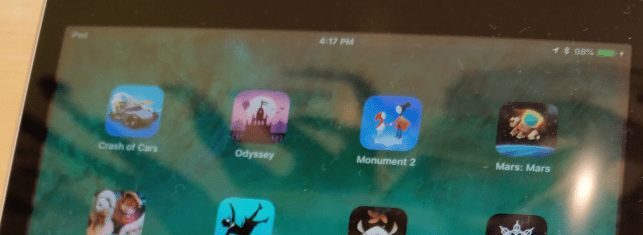
The real reason I bring up Monument Valley 2 is because of something I noticed when I was in an Apple Store the other day, getting a new iPad for my Dad. On their demo devices, the game is labeled simply as “Monument 2,” because the name is too long. Notice also that the game Alto’s Odyssey is just named “Odyssey.” I’ve wondered what Jack and I should do with our lengthy title Where Shadows Slumber… should it be listed as “Slumber,” “Shadows Slumber,” or “Shadows?”

AppIcon-AltosAdventure

Speaking of Alto’s Odyssey, both games in the Alto series have very beautiful app icons. However, it seems to me that the original is better because it actually communicates the mechanics of the game. Take a look at the icon above, and then look at Alto’s Odyssey below. Remember that these games have identical gameplay: both are side-scrolling snowboarding simulators. Notice anything?

AppIcon-AltosOdyssey.JPG

Alto’s Odyssey doesn’t have an image of a dude flipping over a windmill like the first game did! That’s pretty important because the whole game is about jumping over stuff, getting airtime, and doing tricks. But when I see the icon above for Alto’s Odyssey, I imagine a different game where I can actually go into some of those ruins or fly in that hot air balloon. It doesn’t set up expectations the way you might expect. Even so, the image is gorgeous and communicates the art style faithfully.

AppIcon-Prune

Of all the games I researched, my favorite app icon is probably the one for Prune. Look at this beautiful picture! Since I played the game, I happen to know that this app icon is actually a perfect rendition of what every Level looks like, too. Now that’s honesty! Prune is a game where you swipe away branches from a tree to help it grow the right way. I think you wanted to avoid the big red suns because they killed your tree. It’s a beautiful game, and the simple nature of this app icon does it justice.

We’ve looked at a lot of great artwork, but I don’t feel like comparing them to a list of “bad examples” in this blog post. I feel uncomfortable putting down other people’s work besides my own. There is no point in searching the App Store for apps that performed poorly and then ripping their icons apart. Instead, let’s just criticize the two icons I made earlier in the project cycle!


AppIcon-Gallery.png

Learning From My Mistakes

If you’ve ever played our free iOS Demo before, or if you are one of our beta testers, or even if you’re just a diehard follower of this blog, you’ve seen one of our app icons before. We aren’t going to use either of these for the final game’s release, so I’d like to write about them in this space.

AppIcon-WSS-2016.JPG

Our first app icon was created just for the Demo. I whipped this up in Adobe Illustrator over a year ago. The idea was to show a silhouette of Obe in a doorway, with the lantern clearly visible. Looking back on it now, this fails for a variety of reasons:

  1. This image is very detailed, so the intricacies are hard to make out at small sizes
  2. This icon requires pre-existing knowledge about what Obe looks like
  3. The lantern looked weirder back then, so it’s not immediately recognizable
  4. This looks like an icon for a horror game, almost like Amnesia for mobile phones
  5. This doesn’t really look like the art in the game at all
  6. This doesn’t really look like an app icon for a mobile puzzle game
  7. This is misleading because Obe’s body never actually casts shadows

I’m not saying I hate it or I regret making it – it seemed cool at the time! Our Demo drew in over 310,000 free installs on Android alone, so we did something right. But I wouldn’t go for this kind of style for the final game. It’s too much of a departure from the real game’s art, tone, and genre.

AppIcon-WSS-2017

Our next app icon was made much faster and was basically an unofficial app icon. I just did this for the beta, and I didn’t put much effort into it. This one fails on two levels – first of all, it’s not very unique or inspiring. It’s just text. Anybody could make this, and it tells customers nothing about our game. Second, it includes English text. That means I’d need to make a different app icon for every language we release the game in! Why bother doing that when I can just create a cool image like ustwo did?

So for the game’s final icon I need one square image that contains no text, but communicates the following to the player:

  • The game’s reflective tone, with some ominous terror looming in the periphery
  • The game’s crisp light shading model
  • The importance of the lantern to the story
  • The idea that this is a puzzle game and not some other genre
  • The idea that this is a mobile game
  • A warning that this game is not for preteen children

Yikes! Wish me luck. I’ll take a shot at this during the week, in between animating the game’s remaining cutscenes and putting out other fires. Jack and I have spoken about our app icon informally in the past, so I have a pretty good idea of what we want. This analysis helped me crystallize my plan going forward.

We’ll have some exciting news to announce in the coming weeks, so stay tuned to this blog and thanks for reading!


= = = = = = = = = = = = = = = = = = = = = = = = = = = = = = = = = = = =

We hope you enjoyed this update about the game’s graphic design. Have a question about aesthetics that wasn’t mentioned here? You can find out more about our game at WhereShadowsSlumber.com, ask us on Twitter (@GameRevenant), Facebookitch.io, or Twitch, and feel free to email us directly at contact@GameRevenant.com.

Frank DiCola is the founder of Game Revenant and the artist for Where Shadows Slumber.


Optics

Hey, it’s me, Jack! For those of you who have been following our blog, you may have noticed that I haven’t posted in a while. You’re probably wondering what happened to me. Did Frank kick me to the curb? Did I abandon Where Shadows Slumber?

In all honesty, you probably didn’t even notice. Whatever the case, I haven’t gone anywhere! The reason I haven’t posted anything in a while is that, simply put, the stuff I’m working on isn’t all that interesting. Compared to action-packed cutscenes and beautiful artistic polish, bug-fixing and number-tweaking are pretty dull.

BugFixesCommit

An enthralling contribution

That’s why, this week, I want to talk about something that isn’t specific to Where Shadows Slumber, and has nothing to do with the work I’ve been doing this past month. Instead, I’m gonna talk about something that applies to everyone – not just in indie game development, but in any business at all!

Optics is an area of business management that is very closely associated with marketing and publicity. However, as its name suggests, it refers less to the way in which you’re introducing people to your product, and more to the way that your product is actually perceived. Optics isn’t an action that you take, it’s more of a general way in which you act about your company and/or product.

Optics – the scientific study of sight and the behavior of light, or the properties of transmission and deflection of other forms of radiation.

That’s not a very useful description, so here’s a quick example:

  • Posting on Facebook, putting up billboards, and going to conventions are all examples of marketing. Note that they’re all specific actions.
  • Deciding to be very transparent about your process, or always being snarky on social media are examples of optics. They’re more like predefined ways to act.

Let’s take a look at how thinking about optics has impacted Where Shadows Slumber.

Warning – as with any conversation about a product’s “image”, this next section may be a little pretentious.

Where Shadows Slumber‘s Optics

So, what are some ways in which we consider the optics of Where Shadows Slumber? Surely, this wouldn’t be a topical blog post if I didn’t discuss our application of the concept!

The answer to this question lies in how we want our users to think about Where Shadows Slumber. Consider the difference between a game like Monument Valley and something like Candy Crush. They’re both great, successful games, but the general public thinks about them differently. Monument Valley is artsy and represents a unique experience, whereas Candy Crush is a well-oiled time-killing machine that you can always open up and play. They’re different, and both successful, in part because they know what they are and how they’re perceived. How do we want Where Shadows Slumber to be perceived?

World-7-Paradise

Where Shadows Slumber – a beautiful, mysterious, puzzle game

Where Shadows Slumber is, at its core, mysterious. When thinking about Where Shadows Slumber, people find themselves wondering: Who is Obe? What is he running from, or to? What do his journey, his light, and his darkness represent?

Where Shadows Slumber is a puzzle game. When playing it, players aren’t simply following a path, but choosing one. They’re engaged, actively trying to figure out the puzzles. They feel a sense of agency – they are in control of the game.

Where Shadows Slumber is, for lack of a better term, art. When looking at it, people appreciate the colors and the aesthetic. They notice the attention to detail and the smoothness of the gameplay. They recognize immediately the time and effort that has gone into it.

I consider each of these things, and everything else that people think about Where Shadows Slumber, to be a part of our optics. When we’re making design decisions, we ask ourselves – “does this design continue to represent our game as an engaging puzzle game?” When choosing color palettes for a level, we wonder – “will these colors result in an image that someone would hang on a wall?” By continuously working toward our desired image with every decision that we make, we do our best to ensure that the public will view the game just as we want them to.


The Team!

Optics doesn’t just apply to the game itself – it applies to anything and everything on which a potential player might judge us. If you find out that a company has unethical business practices, you probably won’t buy their product, even if it’s the best one on the market. The optics of that company, not just the product, has affected your choice when considering it.

DREAM Team

What we want everyone to think about our team

The image that Frank and I portray as a team is just as important as the image that Where Shadows Slumber itself has. Our team optics are very carefully designed – two friends who met in a sketch comedy group in college, who love games so much that they just want to be a part of, and give back to, the indie gaming community? How can you not love that team? They sound like such cool bros! The fact that it’s actually true is just icing on the cake – now our optics include honesty and earnestness!

In fact, there are parts of our image that are purely invented for the sake of optics. Our friendship? It’s a total lie. Frank and I, after working together for nearly 5 years, simply hate each other. Why do you think we want the production of Where Shadows Slumber to be done so much? We don’t want to have to work together anymore!

Note: Sarcasm doesn’t come across very well in a pure-text format – Frank and I are actually very good friends!

17159203_1817437325174646_6524966612565150056_o

Best Friends!

Another example of optics is that note that I just made! I couldn’t let you leave, knowing the truth of our animosity! The truth is that we do hate each other – but it’s better for us if you think we’re best friends!

Note: Again, the above is sarcasm. Please disregard it!

Team

Seriously though, best friends! Frank wasn’t plotting his revenge at the moment this was taken!

As yet another example of optics, please direct your attention to that second note I just made! I have sworn a blood oath against Frank’s life! He has sworn vengeance against my family! A thousand-year feud ensues, ending only with the extinction of the human race!

Note: ……………….

This Blog!

The final thing I want to point out about the optics of Where Shadows Slumber is this blog itself! By being as transparent as possible about our process, and by connecting as much as we can with our fans and potential players, we do our best to present ourselves as a fun, interesting, and relatable team. By discussing the details of the implementation, design, and art of Where Shadows Slumber, we drive home the point that the game itself is an intricate and interesting experience. By offering tips, tricks, and advice for your own games, we give back to the community that we love so much, and establish ourselves as a part of that community.

Optics are an important part of creating any product. Without a part of your team dedicated to putting out a positive image of you and your product, it becomes the responsibility of every person on the team to actively contribute to your product’s optics. The image that you are striving to achieve should inform many of your decisions, whether they be design- or business-related.

Remember, you don’t want to just make a game – you want to look good doing it.


= = = = = = = = = = = = = = = = = = = = = = = = = = = = = = = = = = = =

I hope this little foray into the world of optics helps you to better promote your own products. I don’t hope, however, that it causes you to question everything that we’ve ever said about Where Shadows Slumber! Either way, you can always find out more about our game at WhereShadowsSlumber.com, find us on Twitter (@GameRevenant), Facebookitch.io, or Twitch, join the Game Revenant Discord, and feel free to email us directly with any questions or feedback at contact@GameRevenant.com.

Jack Kelly is the head developer and designer for Where Shadows Slumber.